TREE CABLING & BRACING · HONOLULU, HI · OAHU
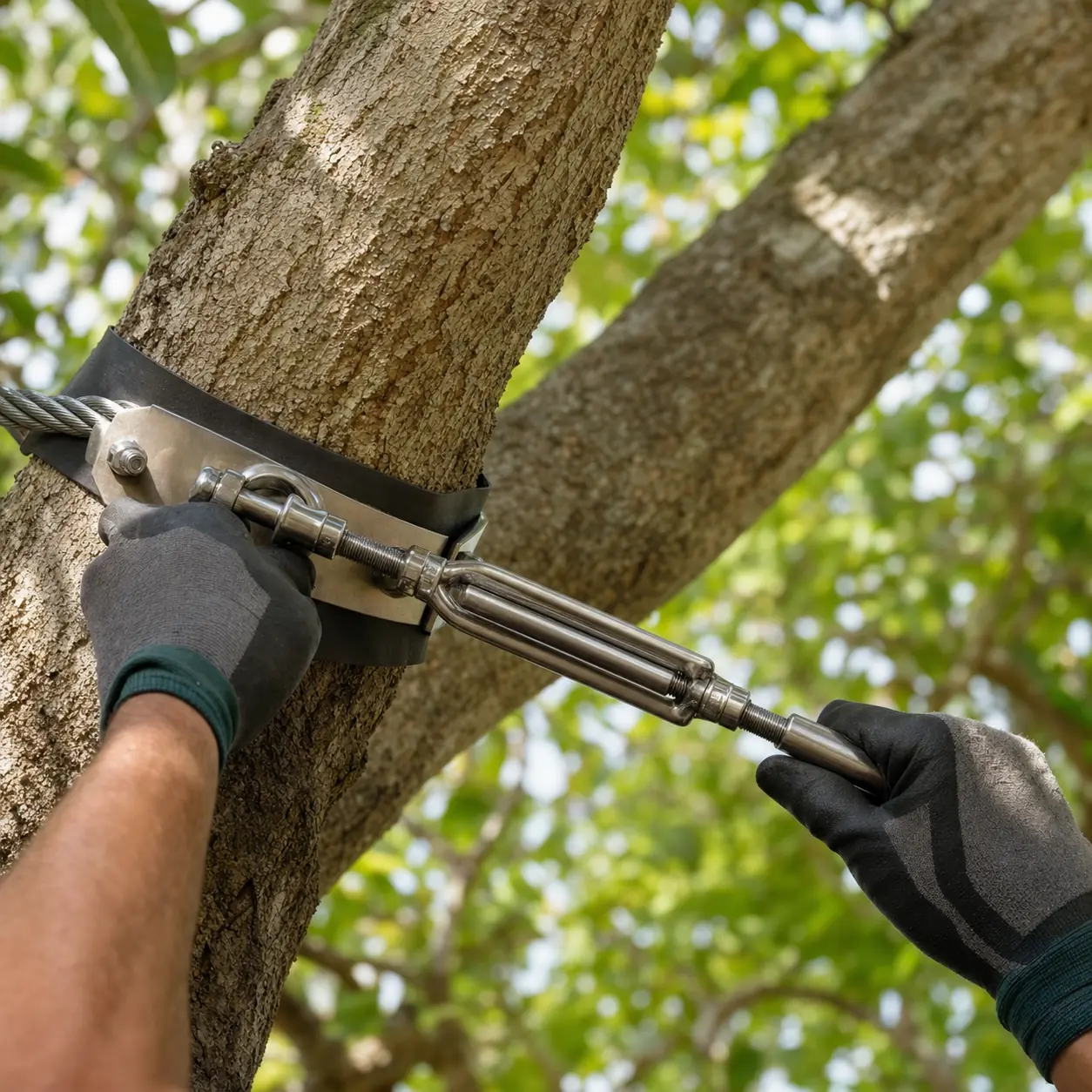
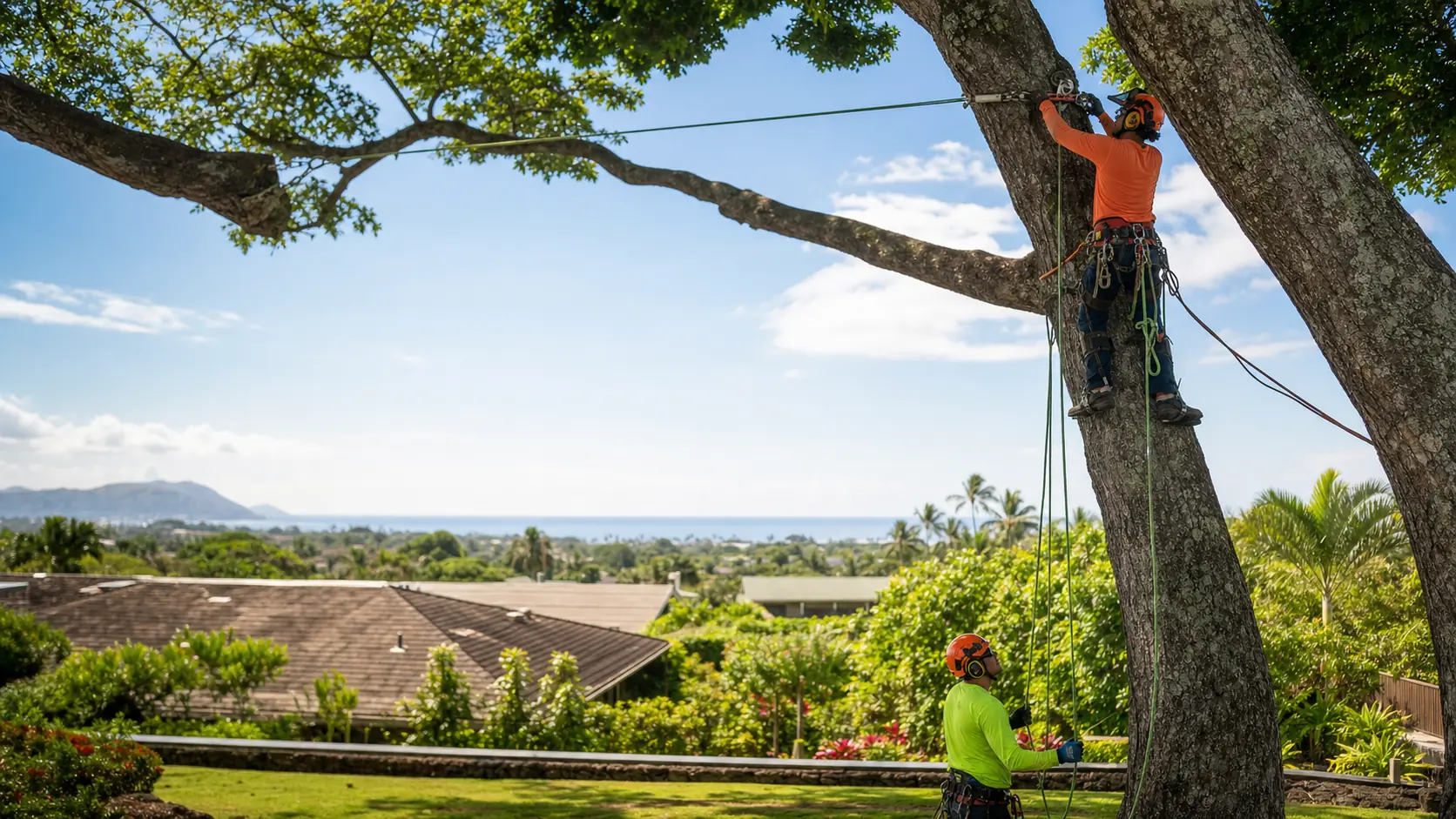
Some trees develop structural weaknesses that don't require removal — they require support. Co-dominant stems (two trunks of equal size growing from the same point) are one of the most common structural defects in Oahu's mature trees. Under trade wind load or during a storm, the split point can fail catastrophically. Cabling ties the two stems together high in the canopy, distributing the load and reducing the risk of failure.
Bracing works at ground level — steel rods installed through the trunk or branch union to stabilize a cracked or splitting section. Together, cabling and bracing let you preserve a mature monkeypod, banyan, or historic specimen tree that would otherwise become a removal. Not every structural defect is a death sentence for the tree.
We install high-strength steel cables and through-rod braces to ANSI A300 Part 3 standards across all Oahu — Kaneohe (96744), Pearl City (96782), Kaimuki (96816), and beyond. Every installation is sized to the tree's load characteristics, not a generic template.
Not sure which applies? Call us — free assessment, no obligation.
THE PROCESS
Cabling and bracing are structural support systems installed inside the tree — not a bandage over the outside. Here is what a properly engineered installation looks like from assessment to completion.
Not every multi-stem or heavy-limbed tree needs cabling. A Certified Arborist assesses the union structure, bark inclusion, limb weight-to-diameter ratio, and the tree's overall vigor before recommending a support system. Sometimes the right answer is selective pruning to reduce load rather than hardware. You get a written assessment and a written price before we schedule any installation.
Static steel cable is used for limbs with a clear, stable anchor point in the upper canopy. Dynamic synthetic systems are better for flexible support that moves with the tree rather than fighting against it — especially on young trees or species that need some movement to develop taper. For split unions or cracked scaffold limbs, threaded steel rods through the union are installed with backing plates at both ends. We specify the correct system in the written plan.
All hardware is installed per ISA supplemental support standards. Cable anchor positions are at two-thirds of the distance from the union to the limb tip — the structural optimum. Rod installations are drilled perpendicular to the split at the correct diameter for the rod gauge. Tension is set at installation and documented. No shortcuts on hardware specification.
A cabling or bracing system is not a one-time fix. Trees grow around hardware, tension changes as limbs develop, and hardware can fail if it is not inspected. We schedule an annual inspection for every installation we do. If the system needs adjustment or replacement, we tell you in writing with the scope and cost.
One thing we always say: cabling and bracing extend the life of a structurally compromised tree — they do not fix the underlying problem. If a union has severe bark inclusion or the split is already extensive, the tree may reach a point where hardware cannot provide adequate support. We assess that threshold honestly and tell you if removal is the better answer for safety.
Ready for a Cabling and Bracing Assessment?
A Certified Arborist evaluates the union structure and tells you whether cabling, bracing, or a different approach is the right call.
WHAT WE HANDLE
Different structural situations require different support systems. We specify the correct hardware after the assessment — not before.
High-tensile steel cable installed between two anchor points in the upper canopy to limit the movement of a heavy co-dominant stem or scaffold limb. Used on mature trees with established canopy structure. Common on large monkeypod and banyan specimens in Hawaii Kai and Kaneohe.
Flexible synthetic rope systems that allow movement while limiting the range of motion under load. Preferred for younger trees and species that need some flex to develop structural taper. Less invasive than steel cable — no through-bolt required.
Threaded steel rods with backing plates installed through a split union or cracked scaffold limb to prevent further separation. Used when a co-dominant stem has already begun to split and the gap needs structural closure. Often paired with cable above the union.
Existing cabling and bracing systems require annual inspection — tension, hardware condition, tree growth around the installation. If you have hardware installed by another company, we can assess and document its current condition.
WHEN A CO-DOMINANT STEM BECOMES A STRUCTURAL EMERGENCY
When two stems of equal size grow from the same point, the bark of each stem can get trapped between them as the union develops. This creates a seam of compressed bark — called included bark — rather than the interlocked wood fibers of a strong union. Under heavy load from wind or canopy weight, included bark unions wedge apart rather than flex and hold. Oahu's trade winds and storm events create exactly those loads.
A cabling system installed above the union limits the range of separation under load — buying time and reducing risk. But the system has to be installed before the split begins, not after. Once a union starts to open, the timeline shortens significantly.
Had a Certified Arborist look at your multi-stem trees lately?
Free on-site structural assessment. Written recommendation — cabling, bracing, pruning, or removal.
Call (808) 207-0841INSURANCE & COST
Cabling and bracing installation is a preventive maintenance measure and is not covered by standard homeowner's insurance as a standalone service. However, if a co-dominant stem or scaffold limb has already failed during a storm and caused structural damage, your dwelling coverage may cover the emergency removal portion of the job.
Some carriers factor the presence of known structural defects — like included bark unions — into claims decisions. A documented assessment and installed support system demonstrates that you took reasonable action. We provide written assessments and installation records for every job.
Cost depends on the number of anchor points, hardware type, tree height, and site access. A single-cable installation on a residential tree is a half-day job. A multi-stem canopy requiring multiple cable runs and rod bracing is a more involved scope. We give you an exact written number after the on-site assessment — never a phone estimate.
Want a straight answer on cost and coverage?
Call us with your details. We give you an exact written price and can tell you whether your situation has any coverage angle.
Tree cabling is a supplemental support system — steel cable, synthetic rope, or threaded rods — installed in a structurally compromised tree to limit the range of movement under load. Trees typically need it when they have a co-dominant stem with included bark, a heavy scaffold limb with a poor attachment angle, or an existing split union that has begun to separate. An ISA-certified arborist makes that determination on-site.
Cabling limits movement and reduces the risk of a structural failure — it does not fix the underlying condition. A union with severe included bark will remain a structural weakness. The question is whether the risk level with the support system is acceptable for the tree's location and value. We give you an honest answer on that during the assessment.
Typically 5–10 years, depending on hardware type and tree growth. Systems require annual inspection and periodic tension adjustment. Trees grow around static hardware, which can affect both the hardware and the tree if not monitored. We schedule annual check-ins for every system we install.
A single-anchor cable installation on a residential tree is typically a half-day job. More complex multi-stem canopies with multiple anchor points and rod bracing are larger scopes. We give you an exact written number after the free on-site assessment.
No. Cabling and bracing require assessment of union structure and load distribution, correct hardware specification, and precise anchor placement — all per ISA supplemental support standards. Incorrectly installed hardware can accelerate the failure it is meant to prevent. This is specialized arborist work.