TREE THINNING · HONOLULU, HI · OAHU
Crown thinning removes selected branches from within the canopy to reduce density without changing the tree’s overall size or shape. On Oahu, where trade winds are constant and hurricane season runs June through November, a dense crown acts like a sail. Thinning reduces wind resistance and the lateral load transferred to the root system and trunk — which is often the difference between a tree that holds and one that fails.
Unlike topping or reduction cuts, proper thinning preserves the natural branch architecture. We remove crossing branches, co-dominant stems, and interior dead wood to open the canopy while keeping the tree’s structural integrity intact. Every cut follows ANSI A300 standards.
Thinning is commonly needed for large-canopy species like monkeypod, banyan, and African tulip that have not been maintained in several years. If your tree has not been thinned in over two years and a storm season is approaching, a pre-season assessment is worth scheduling.
Free estimate · Same-day availability · $0 cost to get a quote
Not sure which applies? Call us — free assessment, no obligation.
THE PROCESS
Thinning is the selective removal of interior branches to reduce canopy density — not a general shape cut. Here is what that looks like on every job.
A Certified Arborist assesses your tree's canopy density, internal branch structure, and the balance between live wood, dead wood, and crossing branches. They identify which interior branches to remove to achieve the target airflow and light penetration without over-thinning. You get a written scope and a written price before we schedule.
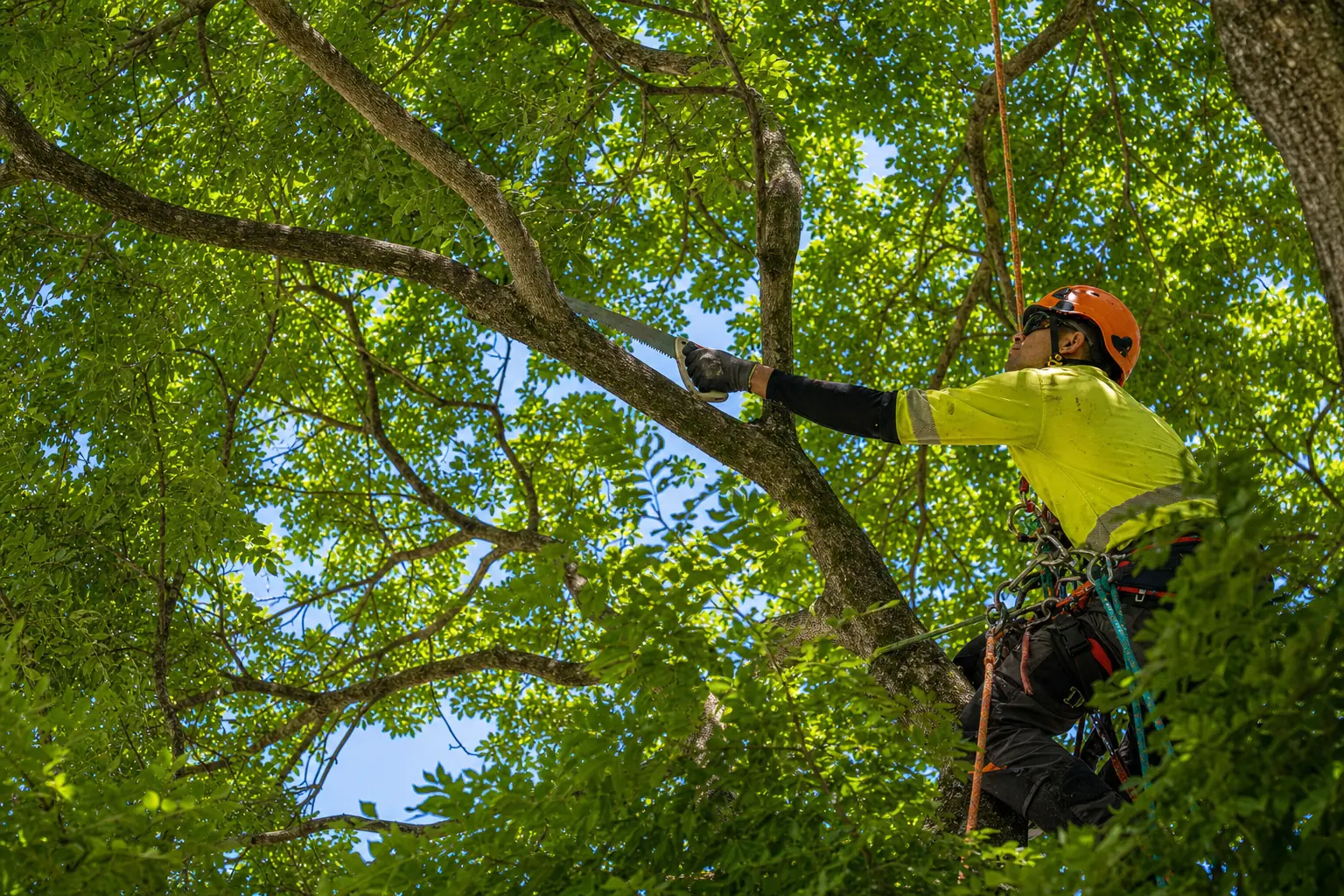
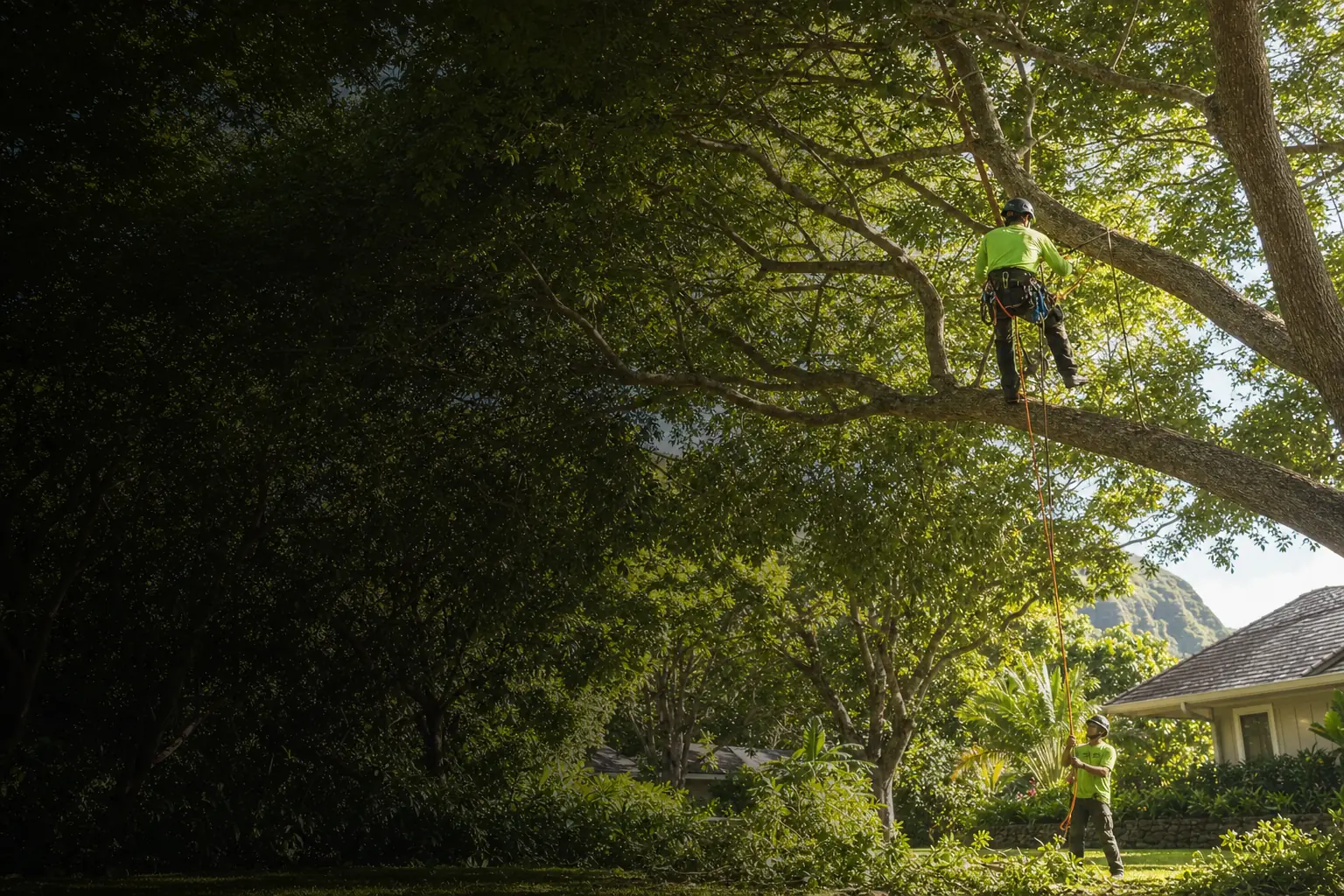
Thinning removes specific interior branches — typically crossing, rubbing, or competing branches — while leaving the canopy's outer silhouette largely intact. Every removal is made at the branch collar. On dense Oahu species like African tulip and monkeypod, our climbers work inside the canopy to reach branches that cannot be accessed from outside.
Every removed branch and chip leaves with the truck. No pile at the curb, no debris on the lawn. If you want chip material kept for garden mulch, tell us before the job starts. Haul-away is included on every Oahu thinning job.
Before-and-after photos provided on request. HOA and commercial jobs include a written job report as standard. Our workmanship warranty covers the scope — if a branch we agreed to remove was missed, we come back and complete it. No charge.
One thing we always say honestly: thinning improves airflow and light penetration and reduces wind resistance — but it does not fix structural problems. If we find co-dominant stems with included bark, large dead sections, or signs of root compromise during the assessment, we will tell you what those mean for the tree's long-term outlook before you commit to the job.
Ready to Thin Your Tree's Canopy?
A Certified Arborist assesses canopy density and gives you a written scope and price. No pressure, no guesswork.
WHAT WE HANDLE
Different thinning objectives require different approaches. We assess which applies before any work is planned.
Reducing canopy density before storm season to let wind pass through rather than build pressure against the canopy as a whole. Especially important for large-crowned species like monkeypod and banyan on exposed Oahu properties — Kaimuki ridge lots, Hawaii Kai waterfront, and Kaneohe windward-facing yards.
Selectively opening the canopy to improve light penetration to garden beds or structures below, and to improve air circulation through the canopy — which reduces fungal disease pressure. Common in Manoa and Nuuanu where high rainfall and dense canopies combine.
HOA communities across Kaneohe (96744) and Hawaii Kai (96825) often have canopy management requirements in their governing documents. We provide COI, before/after photo documentation, and written board reports as standard on every commercial thinning job.
Mango, lychee, avocado, and other fruiting trees benefit from interior thinning to improve light penetration into the fruiting zones. We time thinning around each species' fruiting cycle — cutting at the wrong time can affect the harvest. We assess and advise before any work starts.
WHY DENSE CANOPIES FAIL IN OAHU'S TRADE WINDS
Honolulu's trade winds average 15–20 mph year-round. A dense, unthinned canopy creates maximum wind resistance — the load transfers to the trunk and root system at the worst possible angles. Selective thinning lets wind pass through the canopy rather than push against it, significantly reducing the risk of branch failure or uprooting during Kona wind events and winter storm systems.
Thinning also reduces disease pressure. Dense Oahu canopies in high-rainfall areas like Manoa and Kaneohe trap moisture and reduce airflow — exactly the conditions where fungal diseases spread fastest. A well-thinned canopy is a healthier canopy.
Do not head into storm season with an unthinned canopy.
We are available same-day across Oahu. Free assessment — honest advice on what your tree actually needs.
Call (808) 207-0841INSURANCE & COST
Canopy thinning is preventive maintenance — and maintenance is not covered by standard homeowner's insurance. However, if a branch from an unthinned canopy has already caused damage to a structure, your dwelling coverage may pay for the repair and debris removal, not the thinning that would have prevented it.
The important distinction: a branch failure during a storm is a covered event. A branch you knew was overloading the canopy but did not address may be treated as a pre-existing condition by some carriers. For post-storm damage, see our emergency tree service.
Cost depends on tree size, species, canopy density, and site access. A small ornamental in an open yard is much less than a large mature monkeypod in a tight Kaimuki side yard. We give you an exact written number after a free in-person assessment — not a phone-only estimate. Most residential thinning jobs across Pearl City, Aiea, and Kaneohe are completed in a single day.
Want a straight answer on cost and coverage?
Call us with your details. We give you an exact written price and can tell you whether your situation has any coverage angle.
Thinning selectively removes interior branches to reduce canopy density — the outer silhouette of the canopy changes very little. Trimming reduces size and shape, bringing branches back from structures and controlling canopy spread. A tree can need thinning without needing size reduction at all. We assess which applies during the free consultation.
ANSI A300 guidelines recommend removing no more than 25% of the live crown in a single thinning session. Over-thinning stresses the tree and can trigger excessive regrowth in the wrong places. The right percentage depends on the species, its current condition, and the objective — we assess this during the on-site visit.
Cost depends on tree size, canopy density, species, and site access. We give you an exact written number after a free in-person assessment — never a phone-only estimate.
For most hardwood species, Oahu's drier months — roughly April through October — allow cut sites to heal with lower fungal risk. However, thinning for storm preparedness should be done before storm activity, which may mean working during the wet season. We advise on timing for your specific species during the assessment.
Yes — improved airflow through a thinned canopy reduces moisture retention and makes the canopy environment less favorable for fungal disease. This is especially relevant in high-rainfall neighborhoods like Manoa, Nuuanu, and Kaneohe where dense tropical canopies trap humidity. Thinning is one of the most practical disease management tools available for mature trees.