Crown Reduction Honolulu, HI - Reduce Risk Without Losing Your Tree

Crown Reduction Honolulu, HI — Reduce Risk Without Losing Your Tree

When a tree has grown too large for its space — crowding power lines, shading the roof, or pushing against the fence — crown reduction brings it back into proportion without topping it. ANSI A300 compliant. Serving all Oahu.
Call Now — Free Quote in 60 Seconds When Is Crown Reduction the Right Call?
ANSI A300
On every job
Same Day Quote
Estimates across all Oahu
$0 Estimate
Cost for your estimate

CROWN REDUCTION · HONOLULU, HI · OAHU

Crown Reduction in Honolulu — Bringing a Tree Down to Size Without Killing It

Crown reduction is not the same as topping. Topping cuts branches at arbitrary points, leaving stubs that decay and produce weak regrowth. Crown reduction removes branches back to suitable lateral branches — reducing the tree's overall size while preserving its natural form and the structural integrity of the remaining canopy. The difference in the tree's long-term health is significant.

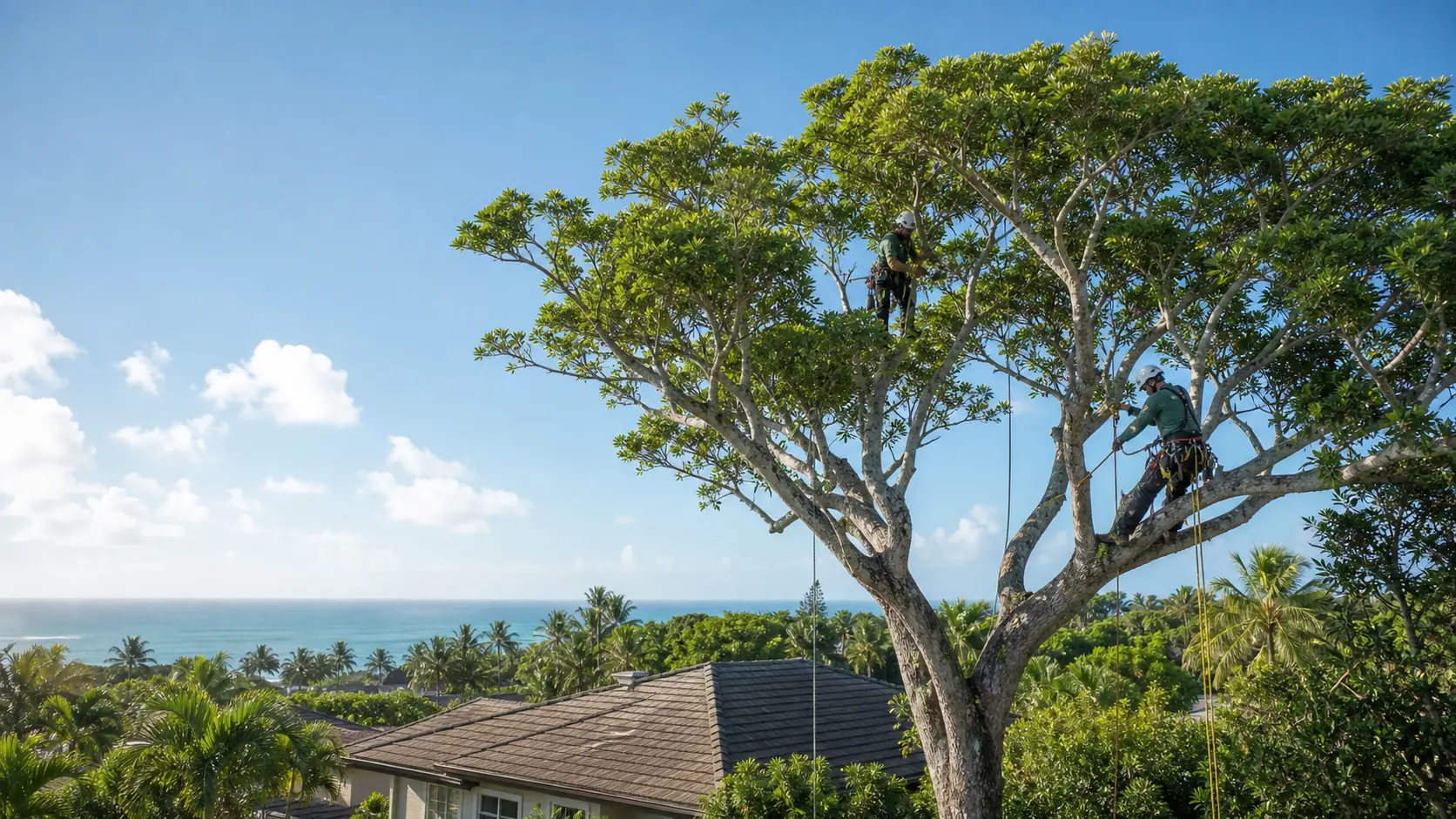
On Oahu, crown reduction is most often needed when a fast-growing species — monkeypod, African tulip, albizia — has outgrown its planted location. A tree that was the right size for a residential yard twenty years ago can now be towering over the roofline, creating shade problems, blocking views, or becoming a wind risk. Reduction brings it back to a manageable size without removal.

We perform crown reductions to ANSI A300 standards across all of Oahu — Kaneohe (96744), Hawaii Kai (96825), Kaimuki (96816), Aiea (96701), and Pearl City (96782). Every cut is made to a lateral branch at least one-third the diameter of the stem being removed — the standard that prevents decay from entering the cut.

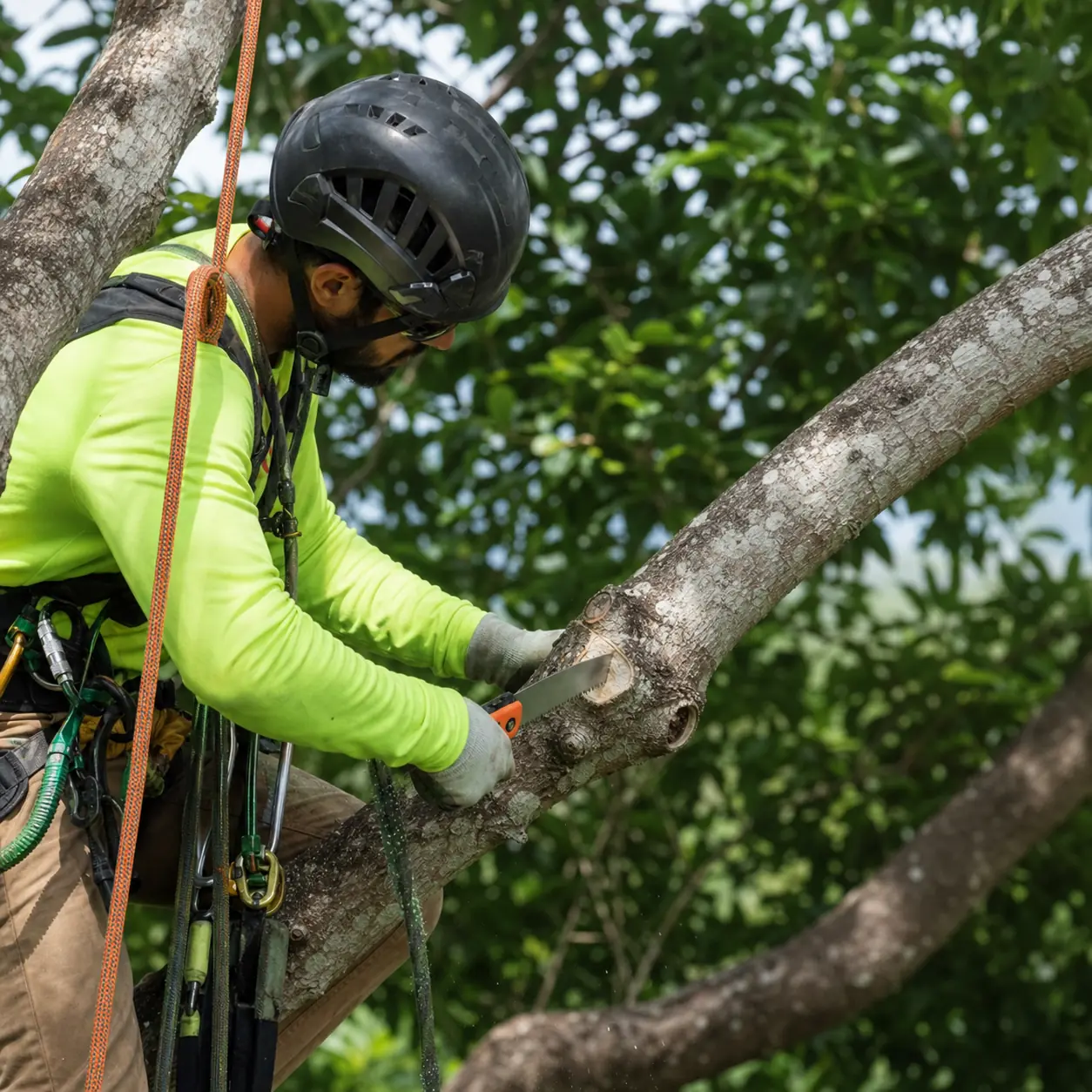
Arborist performing crown reduction on a large tree in Honolulu

Act now when…

  • The canopy is overhanging a roofline, lanai, or carport
  • The tree has grown into or is threatening power lines
  • The tree is creating serious shade or drainage problems
  • The canopy is dense enough to create significant wind load risk
  • Your HOA or municipality has issued a notice about the tree's size

It can wait when…

  • The tree is healthy and not encroaching on any structures or lines
  • A reduction was performed within the last 3 years
  • The concern is purely cosmetic with no structural or proximity issues
  • The tree is a slow-growing species with minimal size increase expected

Not sure which applies? Call us — free assessment, no obligation.

THE PROCESS

See How Crown Reduction Actually Works in Honolulu, HI

Crown reduction is not a shape job. It is a structural operation that requires cutting back every major limb to a suitable lateral branch. Here is what that looks like on every job we do.

01

Free assessment — arborist identifies what the crown actually needs

A Certified Arborist walks the site before any equipment arrives. They assess canopy weight distribution, limb angles, proximity to structures and HECO lines, and the overall health of the tree. You get a written reduction plan — target height, target spread, lateral branch selection — and a written price before we schedule the job.

02

Every cut back to a lateral branch — never a stub, never a flush cut

Crown reduction means cutting each major limb back to a branch that is at least one-third the diameter of the limb being removed. This keeps the tree's vascular system intact and gives the canopy a natural silhouette. We never top. We never leave stubs. On large monkeypods and banyans in tight Hawaii Kai or Pearl City yards, our climbers rig the removed sections down in controlled drops rather than letting them fall.

03

Full cleanup — every section and chip leaves with us

Reduced canopy sections, small branches, and wood chips all leave with the truck. No pile at the curb, no debris on the lawn. If you want chips kept for garden mulch, tell us before the crew starts. Haul-away is included on every Oahu crown reduction job.

04

Documentation and workmanship warranty

HOA and commercial jobs include before-and-after photos and a written report as standard. Every crown reduction comes with our workmanship warranty — if a section we planned to remove was missed, we come back and finish it. No charge, no argument.

One honest thing we always say: crown reduction can significantly improve a tree's safety and structure — but it cannot fix internal decay or a compromised root system. If we find either during the assessment, we will tell you before the job starts. Sometimes the right answer is removal, not reduction. We would rather say that upfront.

Ready to Reduce Your Crown?

A Certified Arborist comes to your property, assesses the canopy, and gives you a written reduction plan and price.

  • Free on-site estimate — no obligation
  • Written plan before any work starts
  • ISA-certified arborist on every job
  • Workmanship warranty on every reduction
Call (808) 207-0841

WHAT WE HANDLE

Crown Reduction Services in Honolulu

Different trees and sites require different reduction approaches. We plan the scope during the free assessment.

Height Reduction

Cutting a tree's overall height back to suitable laterals — the correct alternative to topping. Common on fast-growing species like African tulip and albizia that outgrow their space quickly in Oahu's climate.

Spread Reduction

Reducing lateral canopy spread to clear structures, fences, or neighboring properties. Every cut is made back to a lateral branch — not a stub — to maintain the natural canopy profile and the tree's long-term health.

HOA & Commercial Reduction

HOA-managed properties across Kaneohe (96744) and Hawaii Kai (96825) need documentation before the crew arrives. We provide COI, before/after photos, and board reports as standard.

Power Line Clearance

Canopy encroaching on HECO distribution lines requires Line Clearance Qualified (LCQ) trained crews. If your canopy is already inside the clearance zone, that is a time-sensitive situation — call us today.

WHY OAHU HOMEOWNERS ACT BEFORE STORM SEASON

An Oversized Crown Is a Structural Problem Waiting for the Right Wind

Honolulu trade winds average 15–20 mph year-round, with gusts during Kona events well above that. A large, dense crown transfers that load through the whole tree. If the canopy is disproportionate to the trunk and root system — common in fast-growing tropical species — that load ends up at the weakest point. Crown reduction done before storm season is the correct answer.

Topping is not crown reduction. A topped tree responds with weakly attached water sprouts right at the cut sites — which are more prone to failure than the original branches were. If the tree is too tall, the ANSI A300 answer is a proper size reduction to a lateral. We will show you the difference.

Do not wait for the next storm system.

We are available same-day across Oahu. Free assessment — honest advice on what the tree actually needs.

Call (808) 207-0841

INSURANCE & COST

Does Insurance Cover Crown Reduction in Hawaii?

Routine crown reduction is maintenance, and maintenance is not covered by standard homeowner's insurance. If a limb from an oversized crown has already caused damage to a structure, your dwelling coverage may cover the repair and debris removal — but not the reduction that would have prevented it.

If a storm causes crown failure and structural damage, that is a covered event under most policies. Document everything before cleanup, contact your insurer, and call us. We can assist with job documentation for the claim. For immediate post-storm needs, see our emergency tree service.

Crown Reduction Cost in Honolulu

Cost depends on tree height, species, canopy spread, and site access. A single monkeypod in an open yard is a different scope than a banyan with multiple aerial roots close to a carport in Kaimuki. We give you an exact written number after a free in-person assessment — never a phone estimate. Most residential reductions across Pearl City, Aiea, and Kaneohe are completed in a single day.

Want a straight answer on cost and coverage?

Call us with your details. We give you an exact written price and can tell you whether your situation has any coverage angle.

  • Free on-site estimate — no obligation
  • Written price before any work starts
  • Same-day availability across Oahu
  • ISA-certified arborist on every job
Call (808) 207-0841

Crown Reduction — What Honolulu Homeowners Ask

What is crown reduction and how is it different from topping?

Crown reduction selectively cuts limbs back to suitable lateral branches — maintaining the tree's natural structure while reducing its overall size. Topping cuts limbs to stubs with no regard for branch structure. Stubs cannot close properly, invite decay, and produce weakly attached water sprouts. ANSI A300 prohibits topping. We never top — we only reduce.

How much of a tree's crown can be removed safely?

The general ANSI A300 guideline is to remove no more than 25% of the live crown in a single session. More than that puts the tree under significant stress and can trigger an aggressive, weakly attached regrowth response. The right amount depends on the species and condition — we assess this during the free consultation.

How much does crown reduction cost in Honolulu?

It depends on tree size, species, and site access. A manageable tree in an open yard is much less than a large banyan overhanging a structure. We give you an exact written number after a free in-person assessment — never a phone-only estimate.

Will crown reduction damage my tree?

Done correctly to ANSI A300 standards — cutting to lateral branches of appropriate size — crown reduction is a safe and effective operation. The tree retains its vascular structure and can close the cut sites over time. Done incorrectly (topping, flush cuts, stubs) it is very damaging. The difference is who does the work and what standards they follow.

Do I need a permit for crown reduction in Honolulu?

Not for trees on your private property. Trees in the City and County of Honolulu right-of-way require Division of Urban Forestry authorization. We check right-of-way status during every on-site estimate at no extra charge.

Call Now — (808) 207-0841