PLANT HEALTH CARE · HONOLULU, HI · OAHU
A tree that looks fine from the street can be in serious decline. Early-stage pest infestations, root rot, and soil nutrient deficiencies rarely show obvious symptoms until the damage is already significant. Plant health care is the process of monitoring, diagnosing, and treating these problems before they reach the point of no return.
Honolulu trees face threats that do not exist on the mainland — Coconut Rhinoceros Beetle in palms, Rapid ʻŌhiʻa Death (ROD) affecting ʻōhiʻa lehua, and the scale insects and fungal diseases common in Hawaii's humid coastal climate. Our ISA-certified arborists know what to look for and how to treat it using the least invasive method appropriate for the species.
Regular health monitoring is far cheaper than emergency removal. If your trees have not been assessed in over two years, a health evaluation is worth scheduling before the next rainy season.
Free assessment · ISA-certified arborist · $0 cost to evaluate
Not sure which applies? Call us — free assessment, no obligation.
THE PROCESS
Plant health care is a proactive management approach — not a one-time spray. Here is how we build and deliver a care program for your specific trees and site conditions.
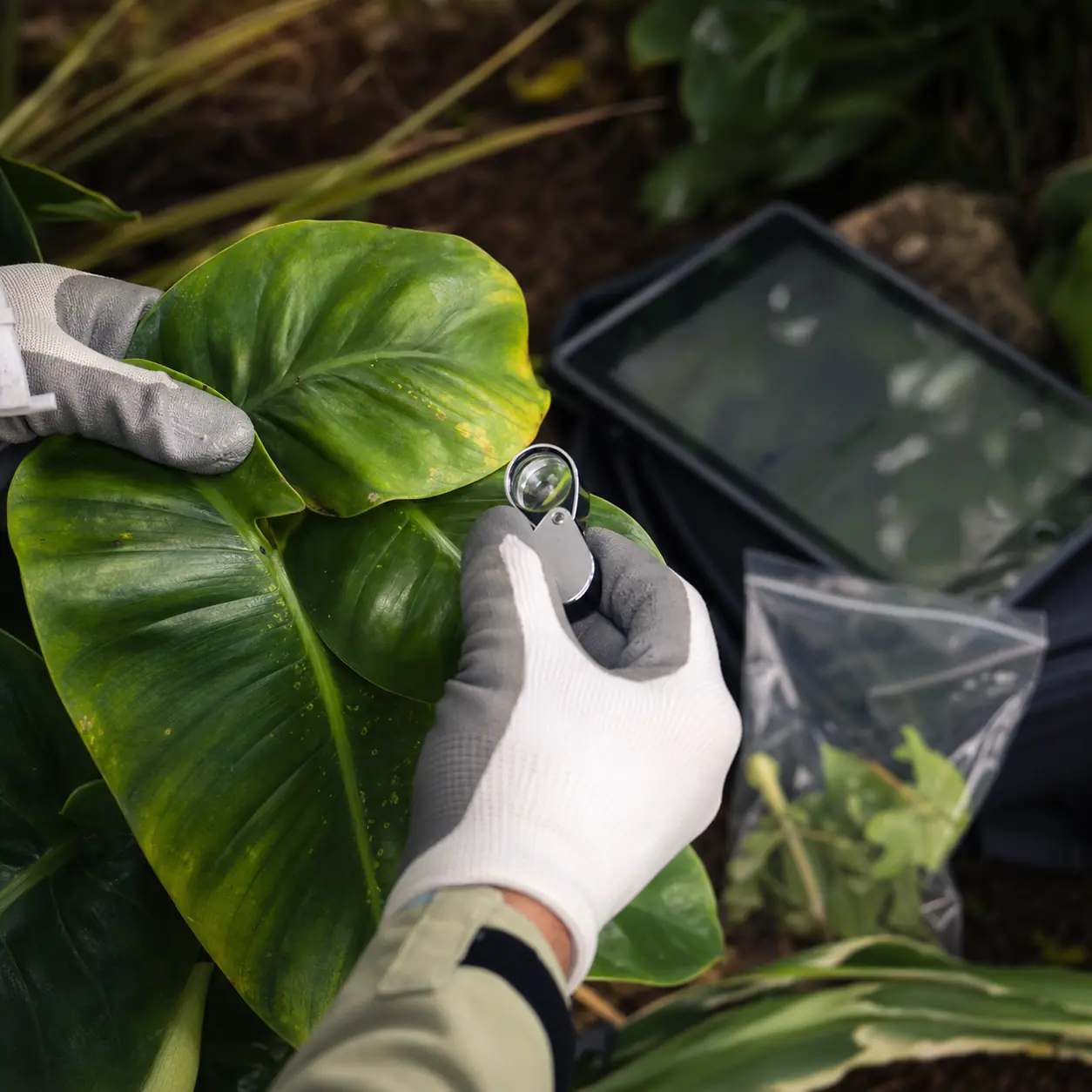
A Certified Arborist assesses each tree or plant you are concerned about. We identify specific pest or disease issues, assess soil conditions at the root zone, and evaluate the tree's overall vigor. We distinguish between a tree that is being attacked by a pest and a tree that is stressed from soil compaction or drainage problems — the treatment protocols are different and mixing them up wastes money.
We do not have a single spray schedule applied to every property. Your care plan is built around the specific species on your site, the specific issues identified, and the specific site conditions — soil type, drainage, sun exposure, proximity to structures. Oahu's climate creates a year-round growing season that means pest and disease pressure is continuous, not seasonal. The plan reflects that.
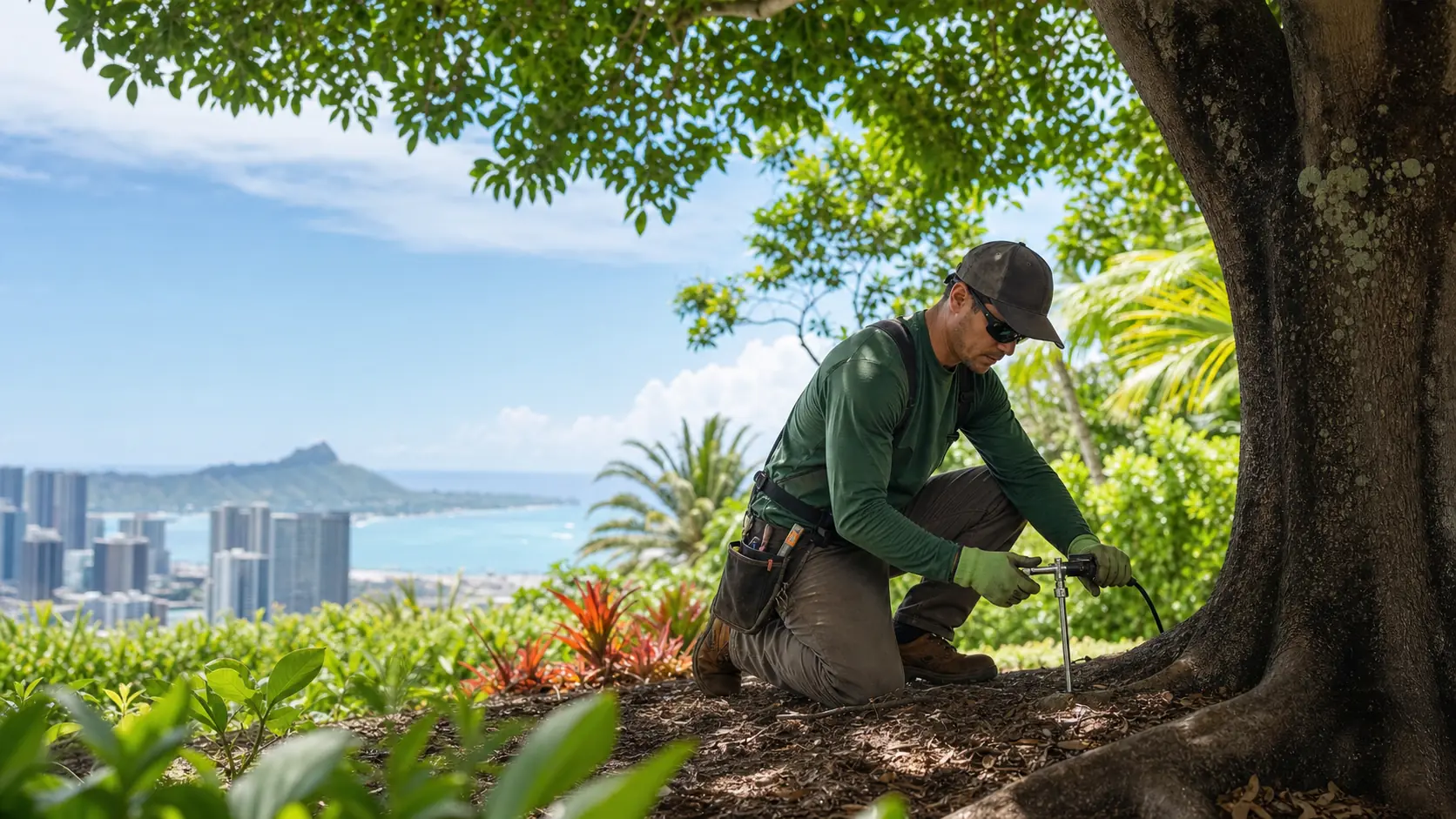
Treatments are applied at the right time for the pest or disease life cycle — not on a fixed calendar. Soil injections for nutrient deficiency, basal bark sprays for fungal issues, growth regulators for stressed trees, and targeted pesticide applications where warranted. All products and methods are documented in writing for every application.
A tree under a health care program is monitored at each visit. If the treatment is working, we document the improvement and continue the program. If a tree is not responding as expected, we adjust the diagnosis and the protocol. You get a written report after every visit — what was done, what was found, and what the next step is.
One thing we are honest about: some trees cannot be saved from advanced disease or severe root damage regardless of treatment. If we identify a tree during the assessment that is beyond the point where a health care program would be effective, we will say so — and recommend removal rather than selling you a program that will not work.
Ready to Start a Plant Health Care Program?
A Certified Arborist diagnoses your trees and builds a care plan specific to your species and site. Free initial consultation.
WHAT WE HANDLE
We address the specific pest, disease, and soil health issues present on your site — not a generic spray program.
Targeted treatment for specific pest pressures common on Oahu: Coconut Rhinoceros Beetle on palms, Erythrina Gall Wasp on coral trees, armored scale on ornamentals, and boring beetle activity on weakened hardwoods. We identify the pest before treating — not a preventive blanket spray.
Fungal disease, bacterial wetwood, and canker management for Oahu species. High-rainfall neighborhoods like Manoa, Nuuanu, and Kaneohe create conditions where fungal pressure is continuous. We identify the specific pathogen and treat accordingly — not every discolored tree has the same problem.
Soil compaction, poor drainage, and nutrient deficiency are the root cause of many apparent disease problems on Oahu. We assess soil conditions at the root zone and treat with soil aeration, organic matter amendment, and targeted fertilization — addressing the cause, not just the symptom.
For properties with significant tree assets — mature monkeypods, palms, heritage trees, and specimen ornamentals — an annual care program provides regular monitoring, preventive treatment, and documented condition reporting. HOA communities and commercial properties across Kaneohe (96744) and Hawaii Kai (96825) frequently maintain annual programs.
OAHU'S YEAR-ROUND GROWING SEASON MEANS YEAR-ROUND PEST PRESSURE
Honolulu's climate — warm, humid, and with minimal seasonal temperature variation — means that pest and disease organisms do not go dormant. Fungal diseases spread during the wet season in Manoa and Kaneohe. Scale insects reproduce continuously on ornamentals in Hawaii Kai and Pearl City. Coconut Rhinoceros Beetle populations do not decline in winter. Proactive monitoring is the only effective defense.
By the time a tree shows visible signs of significant pest or disease damage — sparse canopy, crown dieback, yellowing leaves — the problem is often well established. Early-stage identification through regular monitoring catches issues when treatment is most effective and least costly.
Do not wait until the damage is visible.
Free initial consultation across all of Oahu. We diagnose what is actually happening before recommending a program.
Call (808) 207-0841INSURANCE & COST
Plant health care programs are a maintenance service and are not covered by standard homeowner's insurance. However, documented care programs are useful in insurance contexts: if a tree under active management declines due to a covered peril, the care records demonstrate that the tree was in sound condition prior to the event.
For commercial properties, documented PHC programs are increasingly expected by insurers for properties with significant tree inventories. They demonstrate active risk management and due diligence. We provide written visit reports and annual program summaries suitable for insurance documentation.
Program cost depends on the number of trees included, the specific treatments required, and visit frequency. A single ornamental tree under a quarterly monitoring program is a very different scope from a full commercial property with fifty mature specimens. We build the program and price it after the diagnostic consultation — we do not have a standard package that applies to every site.
Want a straight answer on cost and coverage?
Call us with your details. We give you an exact written price and can tell you whether your situation has any coverage angle.
Plant health care addresses the biological health of your trees — pest management, disease treatment, soil nutrition, and structural monitoring for stress indicators. Trimming manages size and shape. A tree can look perfectly trimmed and be seriously compromised by a pest infestation or root zone problem. PHC and trimming are complementary services that address different aspects of tree management.
The most significant current threats on Oahu include Coconut Rhinoceros Beetle on coconut and other palms, Erythrina Gall Wasp on coral trees (wiliwili), armored scale on ornamentals, and various fungal diseases in high-rainfall neighborhoods. Albizia trees face Fusarium wilt. We identify the specific issue on your site before recommending treatment.
It depends on the tree's species, condition, and specific issues present. Some trees under active treatment need monthly visits. Trees under a monitoring-only program may only need quarterly or biannual visits. We specify visit frequency in the written care plan based on what the tree actually needs.
It depends on the cause and the stage of decline. Many pest and disease issues are treatable if caught early enough. Trees in advanced decline from severe internal decay, structural root failure, or lethal disease may be beyond the point where treatment is effective. We tell you honestly during the diagnostic consultation which situation you are in.
Both, depending on what is actually effective for the specific problem. We prioritize the least-invasive effective treatment — soil amendment and aeration for nutrition issues, targeted biological controls where available, and chemical treatments only when warranted by the severity of the infestation or disease. All products used are documented in writing after every visit.