TREE TRIMMING · HONOLULU, HI · OAHU
Overgrown branches do not just look messy. On Oahu they turn into a roof hazard, a power line problem, or a liability the first time a trade wind storm rolls through. Trees here grow year-round — a monkeypod, banyan, or African tulip that looked manageable twelve months ago can be crowding your carport by now.
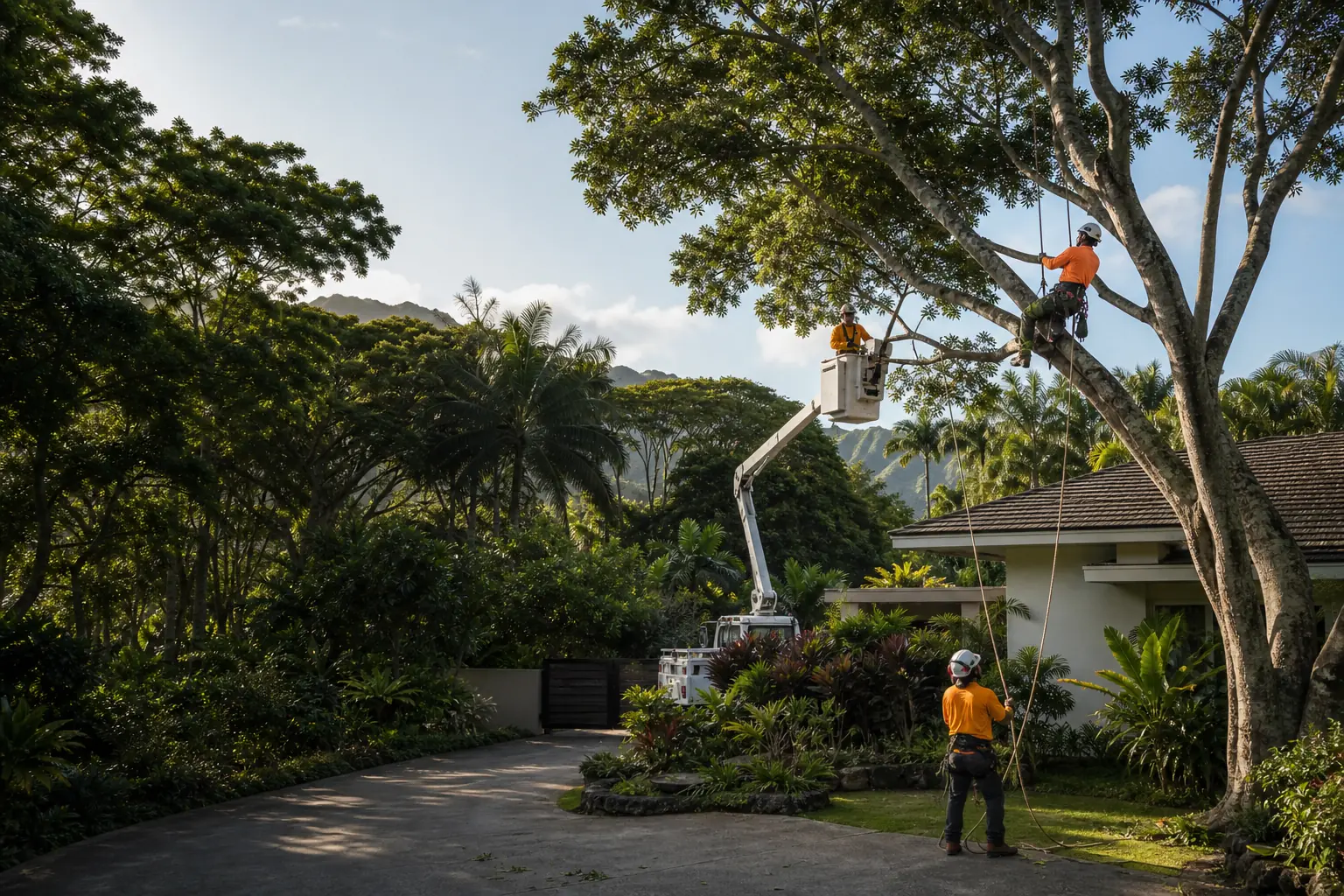
We run ISA-certified crews across the island, from Kaimuki (96816) to Kaneohe (96744), and every climber is trained to ANSI Z133 safety protocol before they touch a saddle. We trim to ANSI A300 standards — which means we plan every cut around the tree’s actual structure, not a generic shape job that damages the branch collar and invites decay.
A trim that ignores how Oahu’s species actually branch can do more harm than good. We will tell you what the tree needs — and if it needs removal instead of a trim, we will tell you that too.
Free estimate · Same-day availability · $0 cost to get a quote
Not sure which applies? Call us — free assessment, no obligation.
THE PROCESS
Most companies show up, cut what looks overgrown, and leave. Here is what actually happens on every job we do — and why each step exists.
A Certified Arborist walks your property, not an estimator. They check species, lean, limb union condition, and proximity to HECO lines. You get a written cutting plan and a written price. No phone-only quotes. No surprises on the invoice.
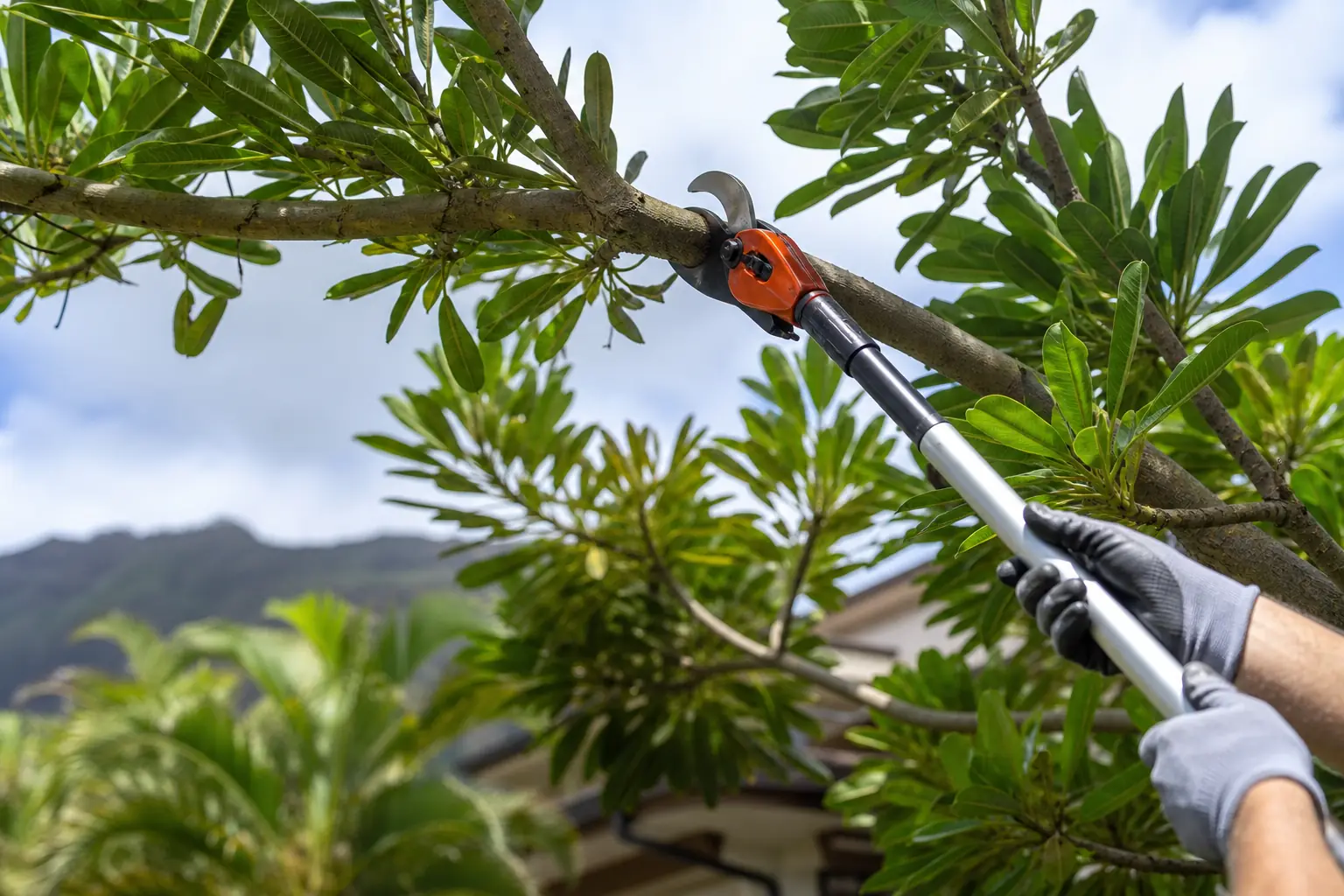
Every cut is made just outside the branch collar — the ring of tissue where the branch meets the trunk. Cut flush and you leave a wound that never seals. Cut too far out and the stub dies back anyway. We cut there every time. For open sites we use an aerial lift. For tight Kaimuki yards, Pearl City carports, and Hawaii Kai pool decks, our climbers rig the branches down in controlled sections. If you have a storm-damaged limb hanging over your roof, that is a different scope — we handle those same day.
We do not leave a pile at the curb and call it done. Everything leaves with the truck. If you want the chips kept for mulch, tell us before the job starts — otherwise everything goes. Haul-away is included on every Oahu job, no extra charge.
Every trim comes with our workmanship warranty. If a cut was made incorrectly or a limb we committed to remove was missed, we come back and fix it. No charge, no argument. HOA and commercial jobs include before-and-after photos and a written job report as standard.
One thing we always say honestly: trimming improves structure and reduces risk — it does not make a tree immortal. If we find internal decay, co-dominant stems with included bark, or root damage during the assessment, we will tell you before the job starts. Sometimes the honest answer is that trimming buys you time but removal is the right long-term call. We would rather say that upfront than take your money and come back in 18 months anyway.
Ready to Get Your Tree Trimmed?
Call us with your tree details. A Certified Arborist gives you a written price — no phone-only guesses, no pressure on the day.
WHAT WE HANDLE
Every job starts with a documented plan, the right gear for the species and site, and a yard left clean when we leave.
Most calls come from yards where a tree has outgrown its space — a carport in Pearl City (96782) or a tight side yard in Kaimuki (96816). We work around fences, pools, and gardens without leaving collateral damage.
Dead fronds and heavy coconut clusters become falling hazards on their own timeline. We remove dead fronds and thin fruit clusters before they become a hazard — and check for Coconut Rhinoceros Beetle damage at the same time.
HOA-managed properties across Kaneohe (96744) and Hawaii Kai (96825) need documentation ready before the crew arrives. We provide COI, before/after photos, and board reports as standard on every commercial job.
Branches growing into HECO distribution lines require Line Clearance Qualified (LCQ) trained crews. If a branch on your property is already touching a line, that is not a wait-and-see situation — call us today.
WHY HONOLULU HOMEOWNERS ACT BEFORE STORM SEASON
Honolulu gets year-round trade winds averaging 15–20 mph, with gusts well above that during Kona wind events and winter storm systems. A dense, untrimmed canopy acts like a sail. The load transfers to the weakest limb union — and that is usually the one over your roof or your neighbor’s car.
Monkeypod and banyan trees in particular develop co-dominant stems that look stable from the ground but can split without warning under lateral load. Trimming before the next weather system is always cheaper than the emergency call after it.
Don’t let it become an emergency call.
We’re available same-day across Oahu. Call now for a free estimate — we’ll tell you honestly what your tree needs before storm season hits.
Call (808) 207-0841INSURANCE & COST
Standard homeowner’s insurance typically does not cover routine trimming — that is considered maintenance, and maintenance is your responsibility. However, if a tree branch has already fallen and caused damage to a structure, your policy’s dwelling coverage often pays for both the damage and the debris removal.
The important distinction: a branch that fell in a storm is a covered event. A branch you knew was dangerous but left alone is a pre-existing condition — and some insurers will deny the claim on those grounds.
Cost depends on tree height, species, and site access. A small ornamental in an open yard costs far less than a tall monkeypod between two houses. Palms are typically quoted separately from hardwoods because frond and fruit removal follows a different labor pattern. We give you the exact number after a free in-person assessment — never a phone-only guess. Most residential trims across Kaimuki, Pearl City, and Aiea are completed in a single day.
Want a straight answer on cost and coverage?
Call us with your tree details. We give you an exact written price and can tell you whether your situation looks like something your insurer would cover.
No. Beyond appearance, trimming reduces wind resistance, removes weak limb unions before they fail, and keeps branches clear of structures and power lines. It is one of the most cost-effective things a Honolulu homeowner can do to reduce storm and liability risk.
Most hardwood species do well on a 12 to 24 month cycle. Coconut palms and royal palms should be checked every 6 months because fronds and fruit clusters accumulate faster. If you have not trimmed in over two years and the canopy is dense, do it before hurricane season.
Not if it is on your own property and is not a City right-of-way tree. Trees in the City right-of-way can only be pruned by the Division of Urban Forestry or a contractor working under their authorization. We check this on every estimate at no charge.
Cost depends on tree size, species, and site access. We give you an exact number after a free in-person assessment — never a phone-only guess. Most residential trims across Kaimuki, Pearl City, and Aiea are completed in a single day.
Hawaii law lets the affected neighbor trim overhanging branches back to the property line themselves, though it is best to talk to your neighbor first. We can handle this for you if the tree is large or hard to access safely — and we coordinate with both parties when needed.