Hazardous Tree Assessment Honolulu, HI - Know the Risk Before the Tree Falls

Hazardous Tree Assessment Honolulu, HI — Know the Risk Before the Tree Falls

A tree that looks fine from the ground can have internal decay, root damage, or structural failure developing where you cannot see it. Our TRAQ-qualified arborists assess the real risk and give you a written report you can show your insurer.
Call Now — Free Quote in 60 Seconds What Does an Assessment Cover?
TRAQ Qualified
On every job
Written Report
Estimates across all Oahu
$0 Estimate
Cost for your estimate

HAZARDOUS TREE ASSESSMENT · HONOLULU, HI · OAHU

Hazardous Tree Assessment in Honolulu — Know Your Risk Before the Tree Decides For You

A hazardous tree assessment is a formal, documented evaluation of a tree's likelihood of failure and the potential consequences of that failure. It is different from a general arborist consultation — the assessment uses a structured risk rating system (typically ISA TRAQ or ANSI A300 Part 9) and produces a written report with a defined risk level: low, moderate, high, or extreme.

Honolulu homeowners typically request a hazardous tree assessment when they suspect a specific tree is dangerous and need documentation for their HOA, insurer, or municipality — or when they want a professional risk rating before making a removal decision. The report is admissible documentation that a known hazard was identified and addressed, which matters significantly if a future insurance claim or liability dispute arises.

We perform ISA TRAQ-based hazardous tree assessments across all of Oahu — Kaneohe (96744), Hawaii Kai (96825), Aiea (96701), Kaimuki (96816), Pearl City (96782). Every report is signed by an ISA Certified Arborist.

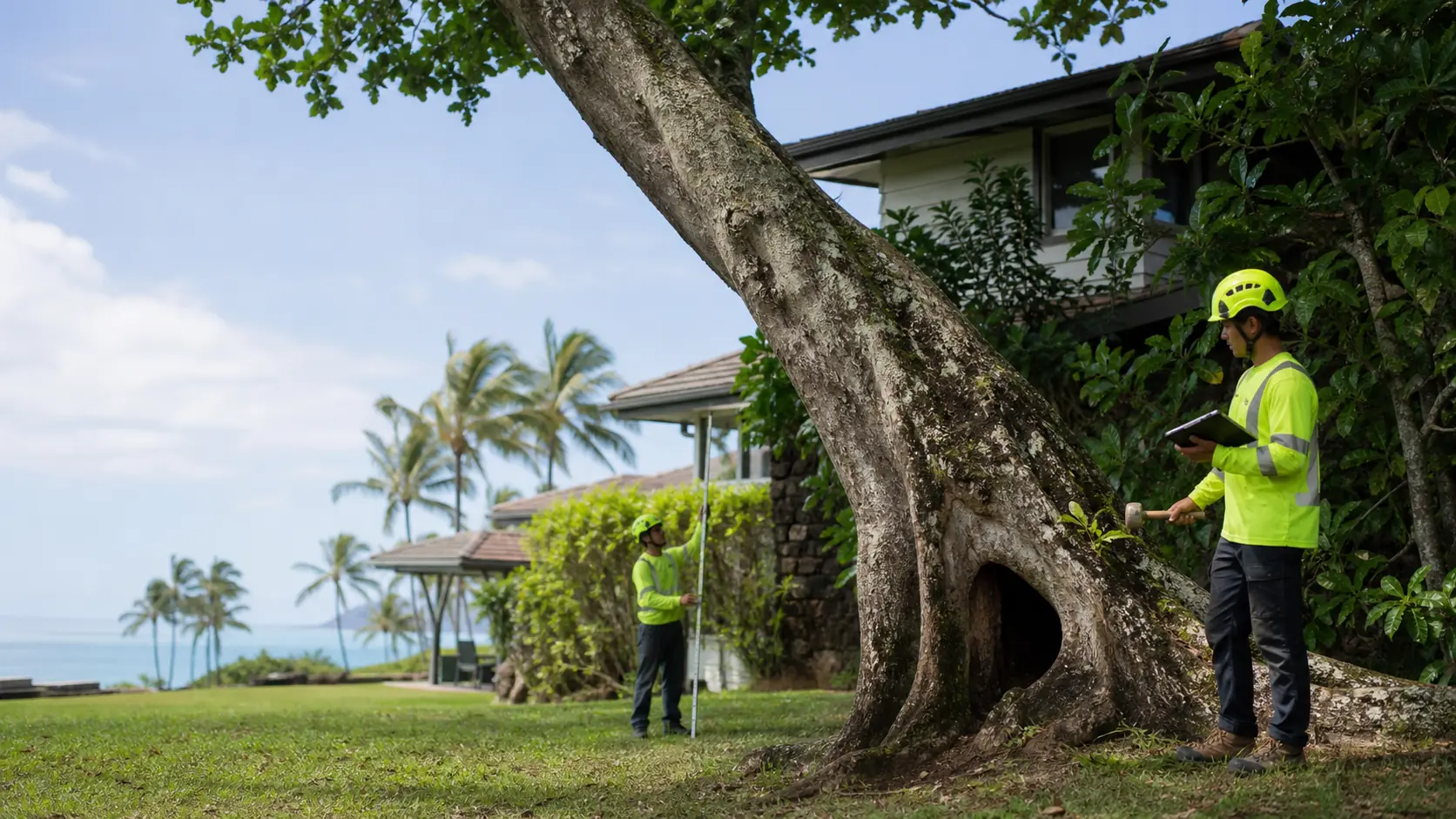
ISA certified arborist conducting a hazardous tree assessment in Honolulu

Act now when…

  • You suspect a tree is a falling hazard and want a professional risk rating
  • Your insurer or HOA is requiring a written hazardous tree report
  • A tree has visible structural defects — cracks, splits, lean, or decay
  • You're purchasing property with large trees and want liability documentation
  • A neighbor has expressed concern about a tree on your property

It can wait when…

  • The tree was assessed by an ISA arborist within the last 12 months
  • No structures, vehicles, or high-traffic areas are in the fall zone
  • The tree is young and healthy with no visible defects
  • The concern is aesthetic, not structural or proximity-based

Not sure which applies? Call us — free assessment, no obligation.

THE PROCESS

How a Hazardous Tree Assessment Works in Honolulu, HI

A hazardous tree assessment is a targeted evaluation of a specific tree that a homeowner is concerned about — not a general property survey. Here is the process from call to written report.

01

Call us with the concern — we triage urgency on the phone

Tell us what you are seeing: is the tree leaning? Did something change after the last storm? Is there visible cracking, fungal growth at the base, or significant root damage from recent construction? We assess whether the situation is urgent — needs a same-day visit — or can be scheduled as a standard assessment within a few days.

02

On-site inspection — we assess the specific failure indicators present

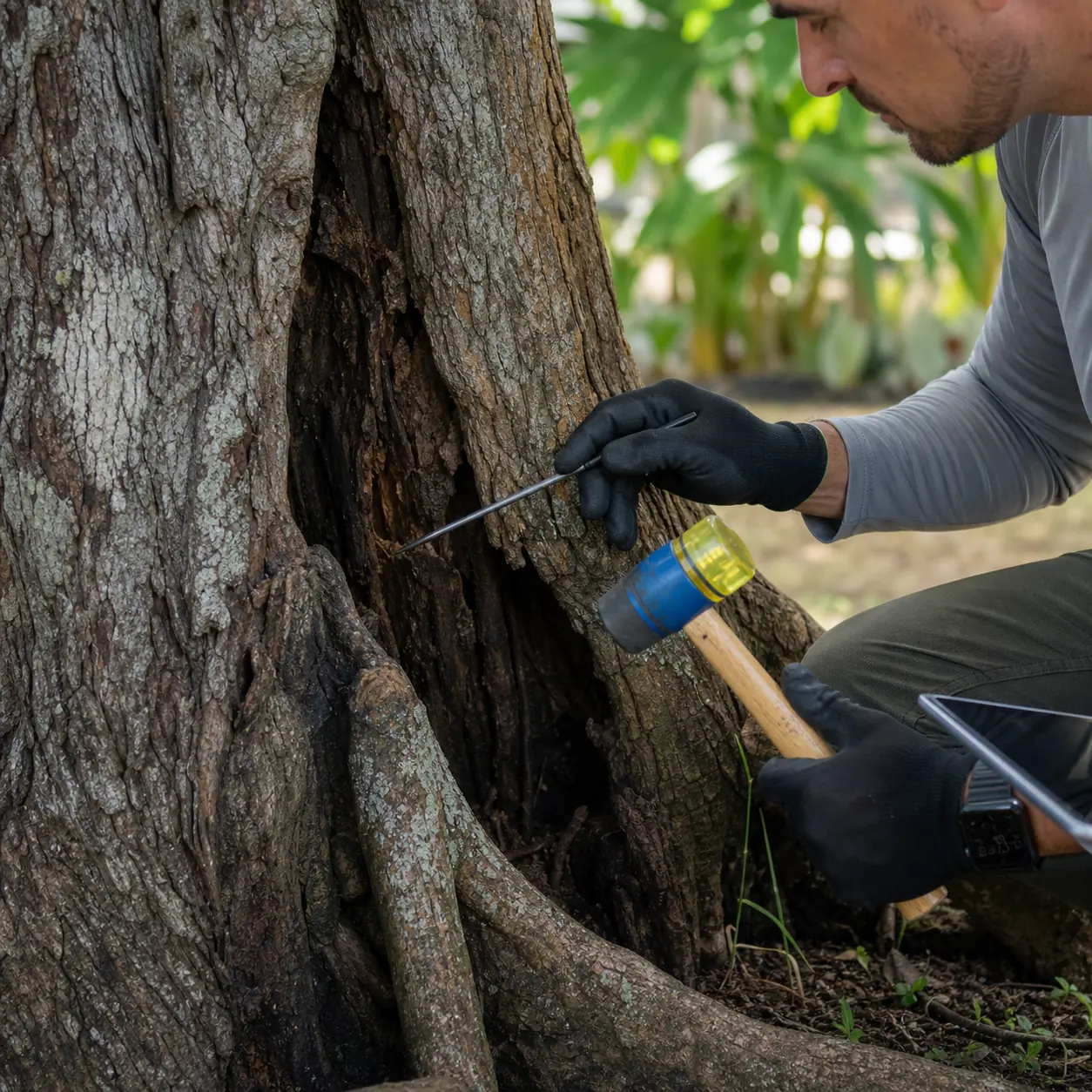
The arborist examines the full tree for the indicators of failure risk: included bark at co-dominant stems, cracks in the trunk or major limbs, decay columns identified by probing and sounding, fungal fruiting bodies at the base or on the roots, root zone disruption, and lean relative to the tree's established growth angle. We assess the target zone — what the tree would hit if it failed — as part of the evaluation.

03

Honest finding — is this tree hazardous, or is it fine?

After the assessment we give you a straight answer. Either the tree presents indicators that warrant action — with specific recommended actions — or it does not, and we tell you why you do not need to be concerned. If the tree is hazardous, we explain what the indicators are, what the risk level is, and what the options are — from mitigation to removal.

04

Written report on request — for insurance, HOA, or legal documentation

For situations where documentation matters — a neighbor dispute, an insurance claim, an HOA compliance issue — we provide a written hazardous tree assessment report documenting the findings, the indicators assessed, and the recommended action. The report is delivered within 24 hours of the on-site visit.

One thing we say clearly: a hazardous tree assessment is a visual and tactile inspection — we do not use internal decay imaging equipment on standard assessments. If there is significant concern about internal decay that cannot be assessed visually, we will tell you, and we can discuss whether advanced diagnostic methods are warranted for your specific situation.

Concerned About a Specific Tree?

We come to your property, assess the tree in question, and give you a straight answer — hazardous or not, and what to do about it.

  • Free on-site assessment — no obligation
  • ISA Certified Arborist on every visit
  • Same-day availability for urgent situations
  • Written report available on request
Call (808) 207-0841

WHAT WE HANDLE

Hazardous Tree Assessment Services in Honolulu

We assess specific trees with specific concerns — not a general canopy survey. Tell us what you are worried about and we will look at exactly that.

Post-Storm Hazard Check

After a hurricane or Kona wind event, trees that look intact may have suffered root plate disruption, internal crack propagation, or loss of structural anchoring that is not visible from the outside. We assess for these hidden failure indicators within 24 hours of the storm passing.

Leaning Tree Assessment

A tree that has started leaning — or has always leaned — in the direction of a structure. We assess whether the lean is a growth pattern the tree has compensated for, or whether it represents active root failure or structural compromise that is getting worse.

Neighbor Tree Hazard Documentation

A tree on a neighboring property that is overhanging your structure or yard. We assess and document the condition of the tree and the specific failure risk to your property. The written report is suitable for use in HOA proceedings, neighbor discussions, or insurance documentation.

Decay and Disease Assessment

Visible signs of internal decay — fungal conks at the base, hollow sections, bark discoloration — assessed for the likely extent of the decay column and the structural impact. We probe and sound the wood and give you a specific finding on what is likely happening inside the tree.

IF THE TREE IS CURRENTLY LEANING TOWARD A STRUCTURE

A Tree Actively Moving Toward a Structure Is Not a 'Wait and See' Situation

A lean that was not there six months ago — or that changed after a storm — is an active structural event. Root plate disruption, internal crack propagation, and loss of ballast on one side of the root system can all cause a gradual lean that accelerates. In Oahu's soil conditions — volcanic clay, shallow root zones on hillside lots — lean events can develop quickly.

We assess same-day for actively changing lean situations. If the tree is already over a structure and the lean is increasing, that is an emergency situation, not a scheduled consultation. Call us and describe exactly what you are seeing — we will tell you whether it is urgent on the phone.

Something changed with that tree recently?

Call us. We triage hazard level on the call and dispatch same-day for urgent situations across all of Oahu.

Call (808) 207-0841

INSURANCE & COST

Hazardous Tree Assessments and Insurance in Hawaii

A written hazardous tree assessment is useful documentation in several insurance contexts. If a tree on your property is assessed as not hazardous and later fails, the assessment shows you took reasonable due diligence. If a neighbor's tree is assessed as hazardous and that documentation is provided to them, it creates a documented notice of the condition — which matters in liability situations.

For insurance claims involving a tree that has already caused damage, a post-event hazardous tree assessment documents the failure indicators that were present — supporting the claim that the failure was a storm event rather than a foreseeable maintenance issue. We provide written reports suitable for insurance purposes.

Hazardous Tree Assessment Cost in Honolulu

The initial on-site assessment for a single tree is free. A formal written report for insurance, HOA, or legal documentation is a separate billable service — we tell you which applies before you schedule. For complex assessments involving multiple trees or situations requiring expert documentation, pricing is provided after the on-site visit. Most hazardous tree assessments across Oahu are completed within one to two hours.

Want a straight answer on cost and coverage?

Call us with your details. We give you an exact written price and can tell you whether your situation has any coverage angle.

  • Free on-site estimate — no obligation
  • Written price before any work starts
  • Same-day availability across Oahu
  • ISA-certified arborist on every job
Call (808) 207-0841

Hazardous Tree Assessment — What Honolulu Homeowners Ask

What makes a tree hazardous?

A tree is considered hazardous when it has a structural defect — included bark, decay, cracks, root damage — and there is a target in the failure zone: a person, a structure, or a vehicle. A tree with the same defects in a remote area with no target may not be classified as hazardous. Both the failure potential and the target exposure matter.

How is a hazardous tree assessment different from a tree risk assessment?

A hazardous tree assessment is a practical evaluation of a specific tree that a homeowner is concerned about — is this tree a problem, and what should be done about it. A formal tree risk assessment is a structured Level 2 or Level 3 evaluation using ISA risk assessment methodology, with documented probability and consequence ratings — typically required for HOA, commercial, or legal proceedings. See our tree risk assessment page.

Can I get a written report from the assessment?

Yes. A written report documenting the findings, the indicators assessed, and the recommended action is available on request. For insurance, HOA, or neighbor dispute purposes, this is a separate billable service — we tell you upfront if your situation warrants one.

What if the hazardous tree is on my neighbor's property?

We can assess and document the condition of a tree visible from your property. For a full assessment of a tree on a neighboring property, the owner's permission is required. If your neighbor is unresponsive and you have documentation of a hazard, that is a matter for your HOA or the City and County of Honolulu — we can assist with the documentation side.

How quickly can you come for an urgent hazard assessment?

Same-day across all of Oahu for urgent situations — a tree actively leaning toward a structure, a tree that changed after a storm, or a large limb hanging partially detached. Call us and describe what you are seeing and we will triage the response time on the call.

Call Now — (808) 207-0841