Tree Risk Assessment Honolulu, HI - TRAQ-Qualified Assessment, Written Report

Tree Risk Assessment Honolulu, HI — TRAQ-Qualified Assessment, Written Report

If a tree worries you — leaning trunk, cracked limbs, roots heaving — a documented risk assessment tells you exactly what you’re dealing with and what to do about it. Required by many insurers before a claim. We serve all Oahu.
Call Now — Free Quote in 60 Seconds What Does a Risk Assessment Include?
TRAQ Qualified
On every job
Written Report
Estimates across all Oahu
$0 Estimate
Cost for your estimate

TREE RISK ASSESSMENT · HONOLULU, HI · OAHU

Tree Risk Assessment in Honolulu — What You Actually Need to Know

A tree risk assessment is a formal, documented evaluation of the likelihood that a tree or tree part will fail and strike a target — a roof, a car, a person. On Oahu, where trade winds and occasional Kona storm systems load trees regularly, the question is not whether a weak tree will fail. It is when, and what it will hit when it does.

Our ISA-certified arborists follow the ANSI A300 Part 9 risk assessment methodology — the same standard used in legal proceedings and insurance claims across the industry. The assessment documents failure potential, failure mode, likelihood of impact, and consequence level, and delivers a written risk rating with recommended mitigation options.

If you have a tree that a neighbor, insurer, or attorney has asked about, a formal written assessment is the only document that carries weight. We provide reports that are defensible, ISA-credentialed, and city-permit ready.

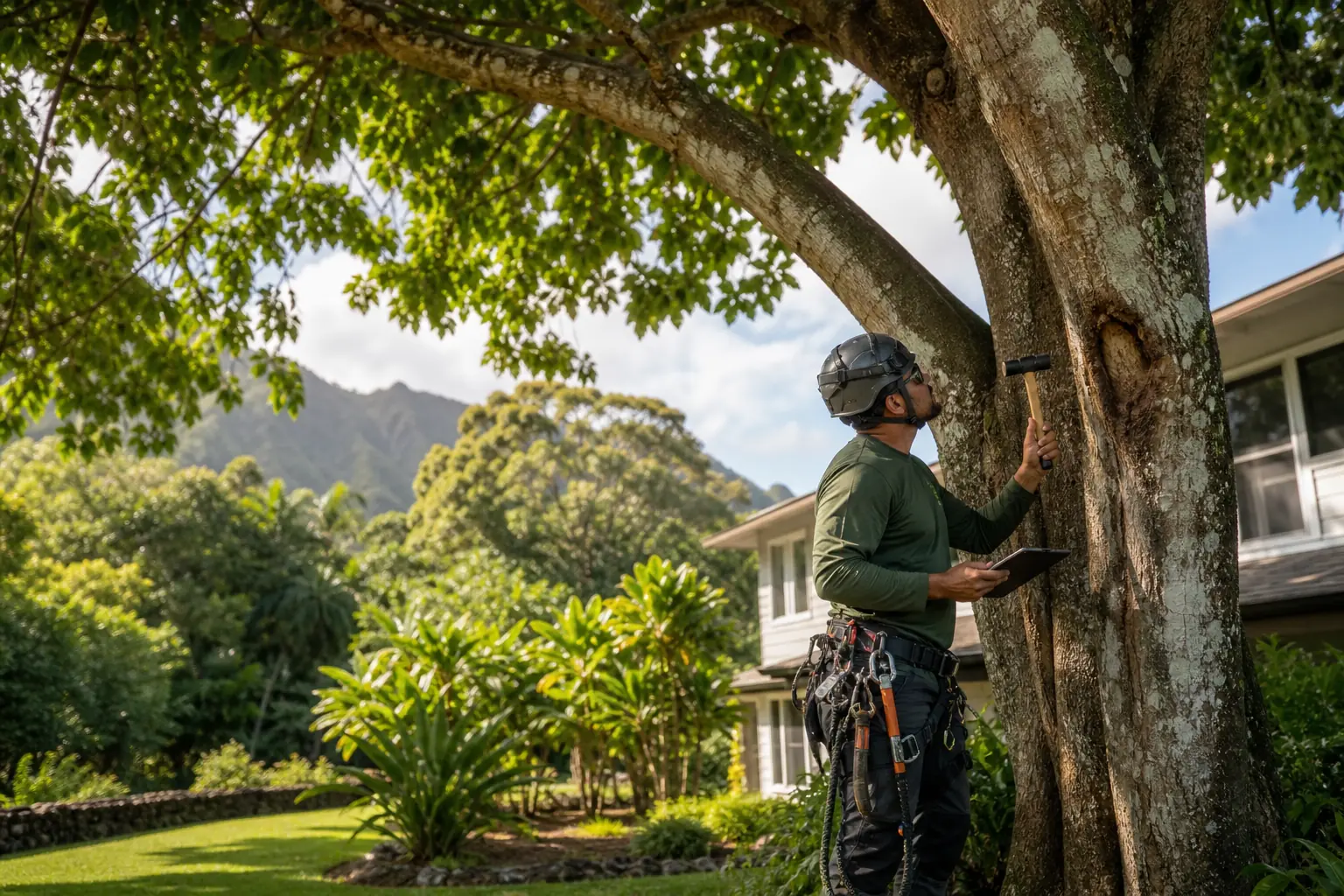
ISA-certified arborist conducting a tree risk assessment in Honolulu

A risk assessment is urgent when…

  • A neighbor or insurer has raised a formal concern about a tree
  • You can see visible structural defects — cracks, lean, dead crown
  • A tree failed nearby and you need documentation of adjacent trees
  • You are buying or selling a property with mature trees
  • A legal dispute or insurance claim involves tree condition

Written ANSI A300 Part 9 report · ISA-certified arborist · Free initial consult

A routine inspection is enough when…

  • Trees look healthy with no visible defects or lean
  • No incidents, complaints, or formal concerns have been raised
  • The tree was assessed within the last 12 months
  • You want a general health check rather than a legal risk document

Not sure which applies? Call us — free initial consult, no obligation.

THE PROCESS

How a Formal Tree Risk Assessment Works in Honolulu, HI

A formal tree risk assessment is a structured Level 2 or Level 3 evaluation — not a general health check. Here is how ISA-qualified risk assessment is conducted for HOA, commercial, and institutional clients.

01

Engagement and scope definition — who needs the report and for what purpose

Tree risk assessment reports are produced for specific clients with specific compliance or liability needs: HOA boards, commercial property managers, municipal agencies, attorneys, and insurers. Before we start, we establish the scope — which trees, what assessment level, and what the report will be used for. Level 2 assessments cover the visible tree from the ground and aerial lift. Level 3 involves advanced diagnostic methods.

02

Systematic assessment using ISA TRAQ methodology

Our ISA TRAQ-qualified assessors evaluate each tree using the standardized ISA Basic Risk Assessment form. For each tree: the likelihood of failure (based on structural defects present), the likelihood of impact (target zone analysis — who or what is in the failure zone and how often), and the consequence of failure (property damage, injury potential). Each variable is scored using the ISA probability-consequence matrix.

03

Target zone analysis — who is actually in the failure zone

A tree risk rating is only meaningful relative to the target. A large tree with significant defects that overhangs an occupied parking lot every day is a different risk profile than the same tree at a remote property boundary. We document target occupancy — how often people or property are in the failure zone — as part of the Level 2 assessment.

04

Written report — Level 2 Basic or Level 3 Advanced, delivered within 48 hours

The written report documents each tree assessed with its assigned risk rating, the specific defects observed, the target zone analysis, and the recommended action: no action required, routine monitoring, mitigation (pruning, cabling, removal of specific limbs), or removal. Reports are formatted for HOA board presentation, legal proceedings, or insurer review as required by the client.

One thing we are clear about upfront: a tree risk assessment report is a professional opinion document that reflects what is observable at the time of assessment. We document what we find and what it means. We are not able to guarantee that a tree rated low-risk will never fail — risk assessment quantifies probability, it does not eliminate uncertainty. We stand behind the methodology and the rigor of our assessment process.

Need a Formal Tree Risk Assessment Report?

ISA TRAQ-qualified assessor delivers a Level 2 or Level 3 risk assessment report for your HOA, commercial, or institutional property.

  • ISA TRAQ-qualified assessor
  • Level 2 Basic or Level 3 Advanced
  • Written report within 48 hours
  • HOA, commercial, and institutional clients
Call (808) 207-0841

WHAT WE HANDLE

Tree Risk Assessment Services in Honolulu

Formal risk assessment is a structured professional service — different from a general health consultation. We tell you which level your situation requires.

HOA Tree Risk Assessments

HOA boards in Hawaii Kai (96825) and Kaneohe (96744) use formal tree risk reports to document due diligence on common-area trees. We provide Level 2 reports formatted for board presentation and insurer review. Multi-tree community assessments are scoped and completed in a single scheduled visit.

Commercial Property Risk Assessment

Commercial property managers across Honolulu need documented risk assessments for liability, insurance, and compliance purposes. We provide Level 2 and Level 3 reports for parking lots, walkways, and occupied spaces with significant tree canopy overhead.

Municipal & Institutional Assessment

Schools, parks, and municipal facilities require risk assessment documentation that meets professional standards for public liability. We provide Level 2 and Level 3 reports following ISA methodology, suitable for state and county agency requirements.

Legal & Insurance Documentation

Tree risk assessment reports are used in property damage litigation, insurance claims, and neighbor dispute proceedings across Honolulu. Our ISA TRAQ-qualified reports are formatted for legal review and can be supported by expert testimony if required.

WHEN DOCUMENTATION IS THE PROTECTION

A Formal Risk Assessment Is Evidence That You Acted on What You Knew

In property damage litigation and insurance claim disputes involving tree failure, the central question is often whether the property owner knew or should have known about a defect. A documented tree risk assessment — showing that the tree was assessed by a qualified professional and assigned a risk rating — is direct evidence that due diligence was performed.

HOA boards that manage common-area trees without formal risk assessment documentation are exposed to personal liability risk under Hawaii law. The standard of care for a property with significant tree inventory — mature canopy, trees over occupied spaces, trees near structures — increasingly requires professional assessment documentation.

Protect your HOA or property with documented risk assessment.

ISA TRAQ-qualified assessment and written report within 48 hours. Call to discuss your scope.

Call (808) 207-0841

INSURANCE & COST

Tree Risk Assessments and Insurance Requirements in Hawaii

Commercial property insurers in Hawaii increasingly require documented tree risk assessments for properties with significant tree inventory. For HOA properties, general liability policies may require evidence of a risk management program for trees over occupied areas. A formal Level 2 assessment with a current date satisfies most insurer documentation requirements.

For properties that have experienced a tree failure event, a post-event Level 2 assessment of all remaining trees demonstrates active risk management and supports the argument that the failure was not foreseeable given the condition of the remaining inventory.

Tree Risk Assessment Cost in Honolulu

Level 2 Basic assessments are priced per tree with a minimum site visit fee. Level 3 Advanced assessments involving diagnostic equipment (resistograph, sonic tomography) are priced per tree with equipment costs. Multi-tree community and commercial properties are quoted as a project scope after an initial consultation to define the tree inventory and report requirements. Contact us for a scope and price specific to your property.

Want a straight answer on cost and coverage?

Call us with your details. We give you an exact written price and can tell you whether your situation has any coverage angle.

  • Free on-site estimate — no obligation
  • Written price before any work starts
  • Same-day availability across Oahu
  • ISA-certified arborist on every job
Call (808) 207-0841

Tree Risk Assessment — What Honolulu Homeowners and HOAs Ask

What is the difference between a tree risk assessment and a hazardous tree assessment?

A formal tree risk assessment uses ISA TRAQ methodology — a structured probability-consequence matrix — to assign a standardized risk rating to each tree. The output is a professional report suitable for HOA boards, insurers, and legal proceedings. A hazardous tree assessment is a practical homeowner-focused evaluation: is this specific tree a problem and what should I do about it. See our hazardous tree assessment page for that service.

What does ISA TRAQ mean?

ISA TRAQ stands for Tree Risk Assessment Qualification — a credential issued by the International Society of Arboriculture to arborists who have completed specialized training in tree risk assessment methodology. ISA TRAQ-qualified assessors are trained to produce Level 2 and Level 3 risk assessment reports using the ISA Basic Risk Assessment form and methodology.

What is a Level 2 versus Level 3 tree risk assessment?

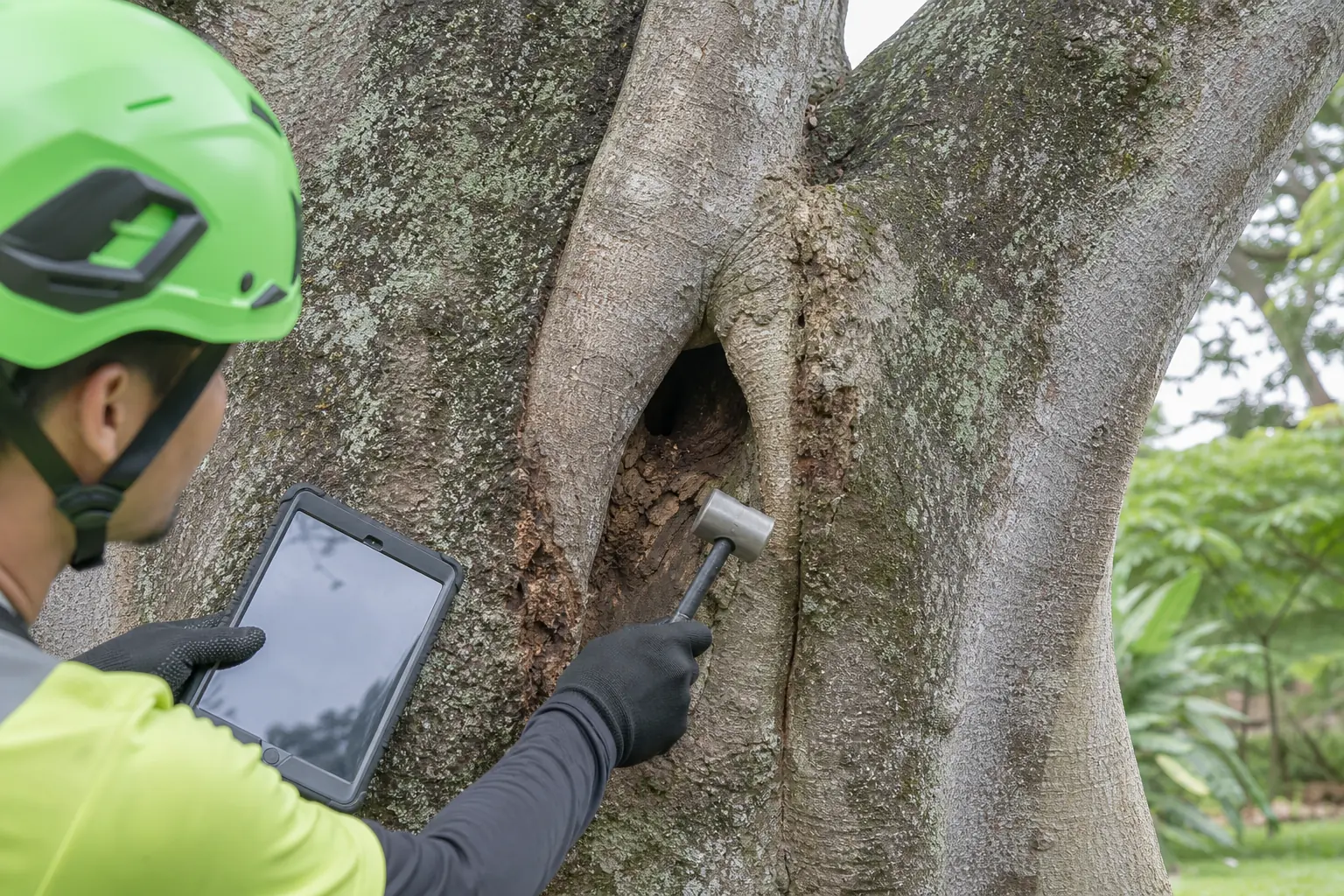
Level 2 is a Basic assessment — a systematic visual inspection of the whole tree from the ground, with aerial lift access for elevated sections when warranted. Level 3 is an Advanced assessment that includes diagnostic equipment such as resistograph drilling or sonic tomography to assess internal decay. Level 3 is indicated when significant internal defects are suspected and the Level 2 assessment cannot adequately characterize the risk.

How often should HOA common-area trees be assessed?

ISA guidance recommends risk assessment of high-value or high-risk trees every 1–3 years, depending on the species, condition, and target exposure. Trees over occupied spaces — parking lots, walkways, play areas — should be assessed more frequently than trees in low-occupancy areas. We recommend an annual program for HOA common areas in Hawaii Kai and Kaneohe.

Can a tree risk assessment report be used in court?

Yes. ISA TRAQ-qualified tree risk assessment reports are accepted as expert documentation in Hawaii property damage litigation. The report documents the specific defects observed, the risk rating assigned, and the recommended action at the time of assessment. Our assessors are available to provide expert testimony if required.