EMERGENCY TREE SERVICE · HONOLULU, HI · OAHU
A tree or large branch that has come down on your property is not a problem you schedule two weeks out. It is blocking access, threatening a structure, or actively damaging something — and every hour it sits makes the situation worse. We run emergency tree response across all of Oahu, including nights and weekends, because that is when these things actually happen.
Most emergency calls we receive fall into one of three scenarios: a tree has fallen on or against a structure; a large branch has come down and is blocking a driveway or road; or a tree has been severely damaged in a storm and is now partially fallen, hanging dangerously over a structure or vehicle. Each of these requires a different approach, and we assess on arrival before any equipment touches the tree.
We cover all of Oahu for emergency response — Kaimuki (96816), Hawaii Kai (96825), Kaneohe (96744), Aiea (96701), Pearl City (96782), and central Honolulu. Call (808) 207-0841 for same-day emergency dispatch.
Not sure which applies? Call us — free assessment, no obligation.
THE PROCESS
When a tree comes down or a limb fails, the sequence matters. Here is how we handle emergency jobs across all of Oahu — and why we do it this way.
Tell us what happened — what fell, where it landed, and what is currently at risk. We ask the right questions to assess the hazard level before we arrive: Is the limb still attached? Is it on a roof, a car, a utility line? Is the tree leaning toward a structure? You get an honest scope and a price range on the call, followed by a written price when we arrive on-site.
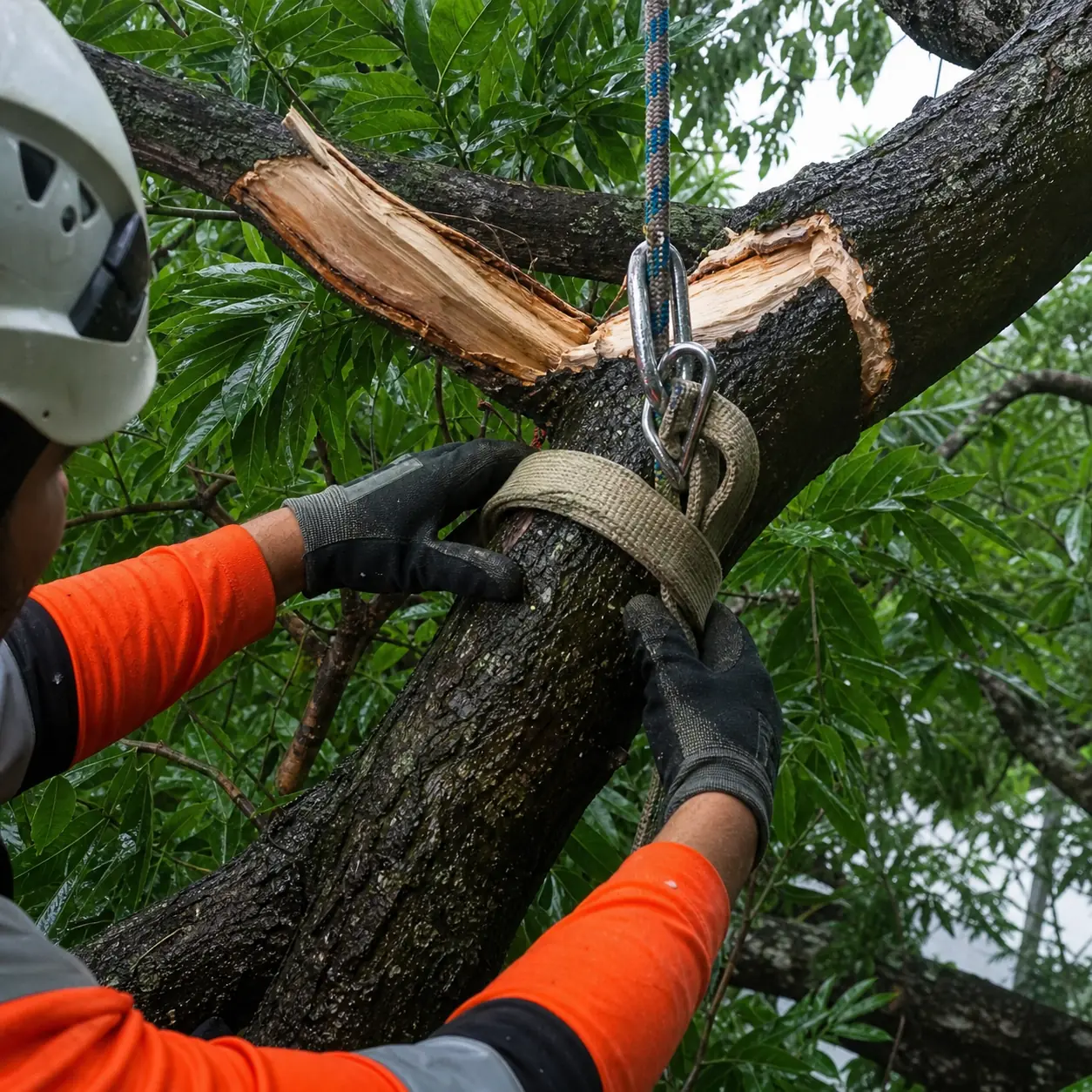
A fallen limb or tree under tension can shift unexpectedly when the first cut is made. We assess the load distribution before touching anything. Bound root plates, limbs pinned under the weight of the trunk, and trees leaning against structures all require a specific cut sequence that releases tension safely. We plan before we cut.
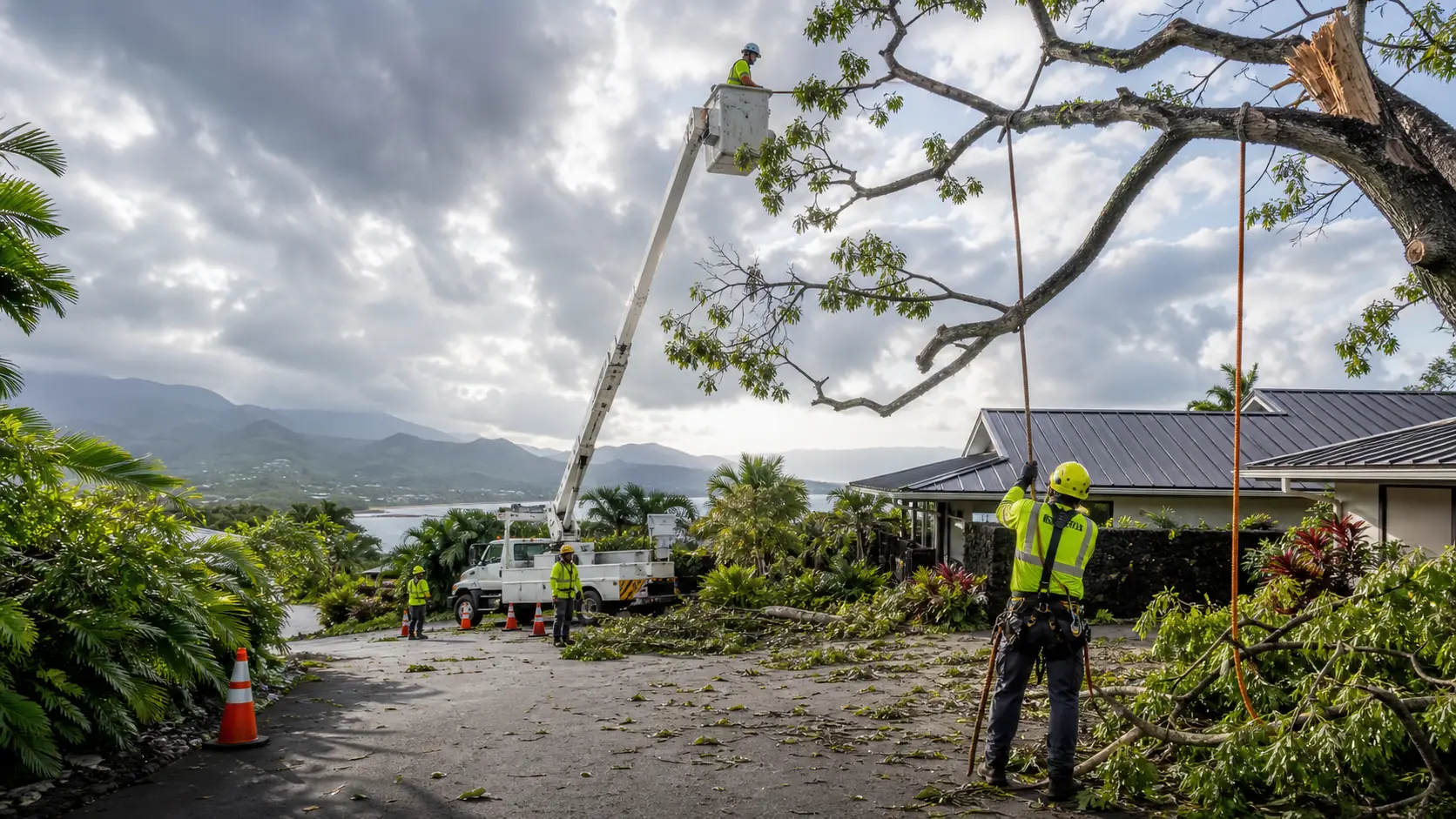
For limbs on structures we rig and lower sections in controlled drops rather than letting material fall. For trees that fell across driveways, carports, or fences we cut and remove in sections. HECO line contact is assessed before any work near power infrastructure — if a line is involved, we coordinate with HECO before proceeding.
Everything comes off the property. No material left at the curb unless you have arranged separate disposal. For storm events affecting multiple properties across a neighborhood, we triage by hazard level and work through the queue. Most emergency jobs across Kaimuki, Pearl City, Hawaii Kai, and Kaneohe are cleared within the same day.
One thing we say on every emergency call: if a tree has contact with an active HECO power line, do not approach it and do not touch anything in contact with it. Call HECO at (808) 548-7311 first. We work around de-energized lines — we do not work on or near energized conductors. We will tell you clearly what we can and cannot handle on the call.
Emergency Tree Down or Limb Failure?
Call us now. Same-day response across all of Oahu. We assess the hazard, give you an honest scope, and clear it.
WHAT WE HANDLE
We handle the full range of post-storm and structural failure situations across Oahu. Call first — we triage by hazard level.
Fallen trees and limbs after hurricane, Kona wind, or trade wind events. We assess load, rig sections in controlled drops, and clear the site. For active HECO line contact, we coordinate with the utility before work begins.
A limb or tree on a structure requires a specific rigging sequence to avoid adding load to already-damaged framing. We assess the structural situation before cutting. Common in Kaimuki (96816) and Pearl City (96782) where mature trees grow close to homes.
Partially attached limbs suspended in the canopy — called widow makers — are the most dangerous condition in tree work. They can release without warning. We do not leave the site until all widow makers in the affected zone are cleared.
A tree that is leaning toward a structure after a storm may not have fallen yet — but the root plate may be compromised. We assess whether the lean is structural failure or natural growth pattern and advise on the correct response before the situation becomes worse.
IF A TREE IS ON YOUR ROOF OR TOUCHING A POWER LINE — CALL NOW
Rain enters through any opening the fallen tree creates. A roof already compromised by the impact continues to degrade with each hour of exposure. The longer a fallen tree or large limb sits on a structure, the more secondary damage accumulates — to framing, to ceiling material, to the structure's drainage capacity.
For HECO line contact: do not approach the tree or anything it is touching. The entire contact area can be energized. Call HECO at (808) 548-7311 to report the contact and request de-energization before any work is authorized. We wait for HECO clearance before approaching line-contact situations.
Do not wait. Call us now.
Same-day response across all of Oahu. We triage by hazard level and dispatch accordingly.
Call (808) 207-0841INSURANCE & COST
Most standard homeowner's insurance policies cover emergency tree removal when a tree falls on a covered structure — roof, fence, carport, or other attached structure. The key is documentation. Photograph the damage from multiple angles before any material is moved. Then contact your insurer before authorizing work.
Policies typically cover the removal of the fallen tree and debris, plus the structural repair. They generally do not cover removal of the rest of the tree still standing — only the part that caused the damage. We can assist with written job documentation, before/after photos, and a detailed removal report for your insurance claim.
Emergency work is priced by scope — the size and species of the tree or limb, the complexity of the removal, access constraints, and whether rigging is required. We give you a written price when we arrive on-site after assessing the situation. Most standard post-storm limb removal jobs across Oahu are cleared same-day.
Want a straight answer on cost and coverage?
Call us with your details. We give you an exact written price and can tell you whether your situation has any coverage angle.
Get everyone out of the area affected by the tree. Do not go inside a structure the tree is resting on until we have assessed whether the load is stable. Photograph the damage from a safe distance before any cleanup. Contact your insurance company before authorizing work — most claims require documentation before removal begins. Then call us.
Yes. Emergency situations do not wait for business hours and neither do we. Call (808) 207-0841. We triage calls by hazard level — active structural damage, power line contact, and widow maker situations are prioritized.
Most standard homeowner's policies cover removal of a tree or limb that has fallen on a covered structure. Document the damage before any work begins, contact your insurer, and we can provide a written removal report for the claim. Coverage varies by policy — your insurer can confirm your specific coverage.
Do not approach the tree or anything in contact with it. Call HECO at (808) 548-7311 to report the contact and request de-energization. We do not work on or near energized conductors. We coordinate with HECO and proceed after clearance is confirmed.
Same-day across all of Oahu in most cases. We dispatch based on hazard level — active structural damage and line-contact situations are prioritized over standing-tree hazard assessments. Call us directly for the fastest response.