TREE PRESERVATION & PLANNING · HONOLULU, HI · OAHU
Construction kills trees more often than chainsaws do. Root zone compaction from equipment, grade changes that bury the root flare, and trench work that severs structural roots are the most common causes of mature tree loss during development on Oahu — and most of it is preventable with a preservation plan established before ground breaks.
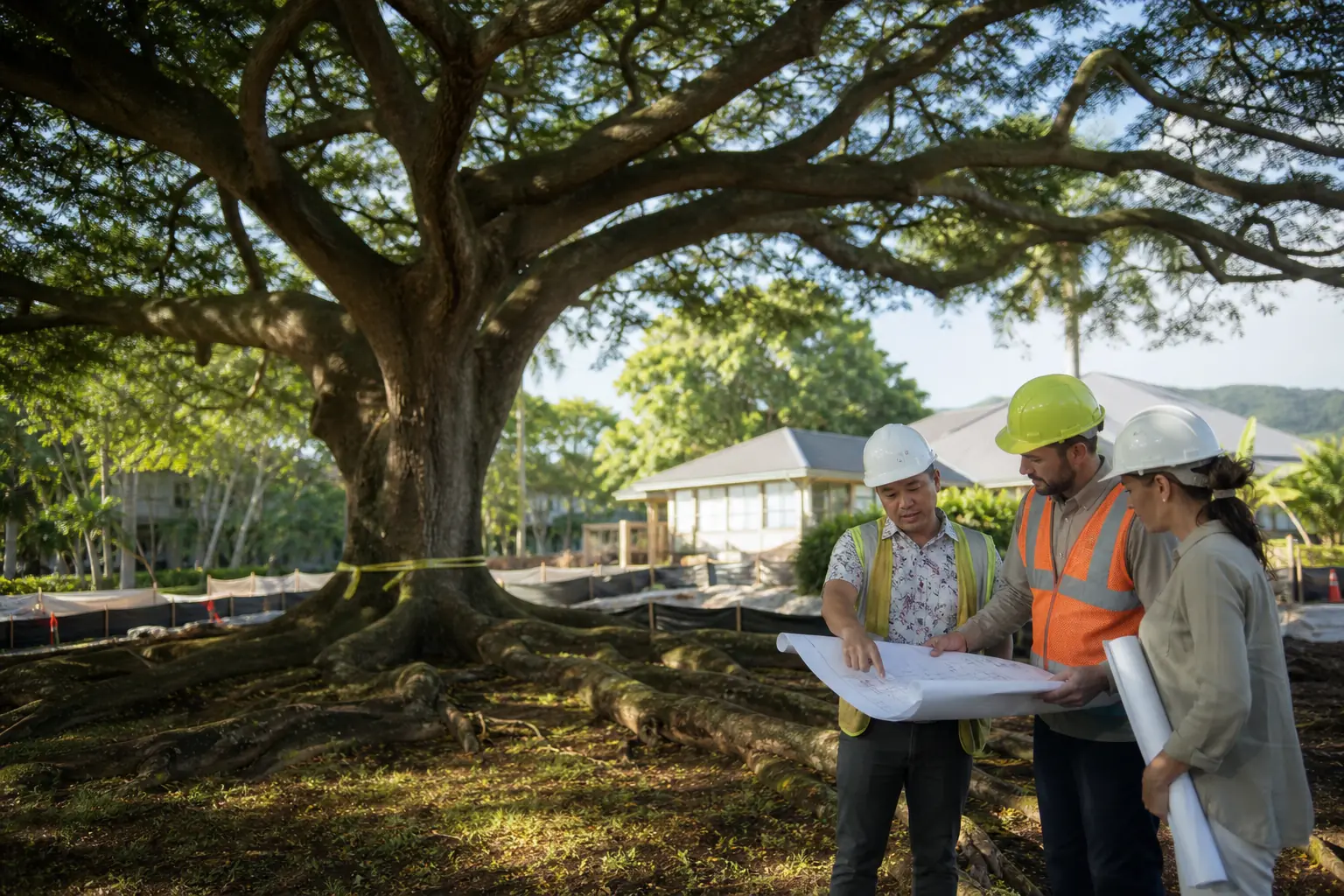
We work with homeowners, developers, and general contractors across Honolulu to identify trees worth preserving, establish protection zones, specify buffer requirements for equipment and material staging, and provide documentation for permit applications. City and County of Honolulu building permits for projects near significant trees often require an arborist report — we produce those reports.
A preserved mature tree adds more appraised value to an Oahu property than a replacement sapling will for twenty years. Getting preservation right during planning is almost always worth the cost.
Free consultation · Arborist reports for permits · $0 cost to discuss scope
Not sure which applies? Call us — free consultation, no obligation.
THE PROCESS
Tree preservation during construction is a technical discipline — not just putting orange fence around a trunk. Here is how we approach it.
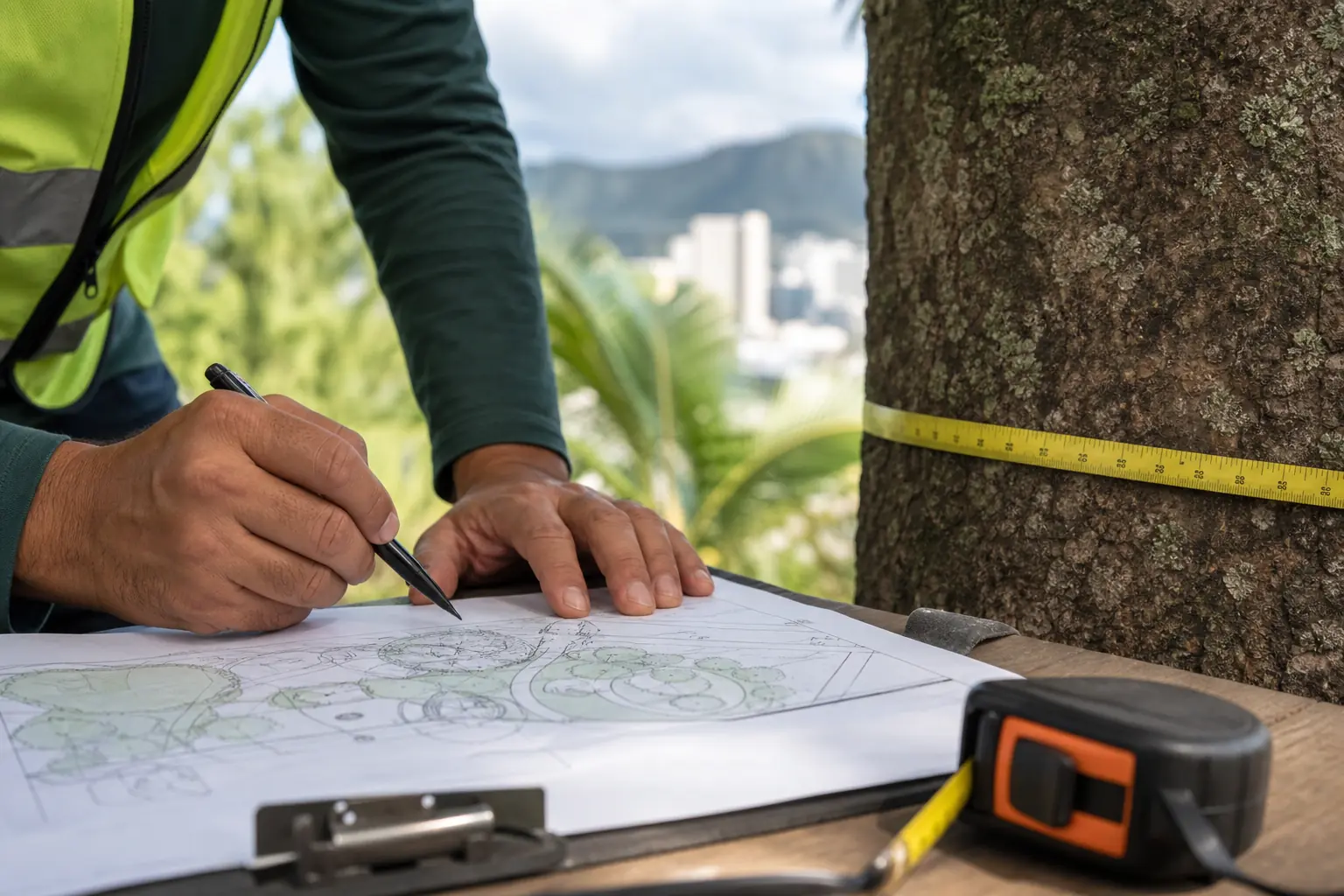
Before a single grade change or foundation layout is set, an ISA Certified Arborist surveys every significant tree on and adjacent to the site. We assess each tree's health, structure, root zone extent, and the likely impact of proposed construction activities on its long-term survival. This survey becomes the basis for the preservation plan — done before engineering, not after.
The most common construction mistake is assuming the root zone matches the canopy drip line. For most mature trees, structural roots extend 1.5 to 2 times the canopy radius, and fine feeder roots extend even further. We calculate the Critical Root Zone for each tree to be preserved and establish protection fencing at the correct radius — not at the trunk, and not at the canopy drip line alone.
We produce a written Tree Preservation Plan specifying: which trees are to be preserved, Critical Root Zone boundaries with dimensions, protection fencing specifications, prohibited activities in the root zone, and the required monitoring schedule during construction. The plan is formatted for Honolulu DPP submission if required, and is provided to the general contractor as a binding site document.
We conduct site visits at critical construction phases: when fencing is installed, before any grading or excavation begins, when underground utilities are routed near the root zone, and after significant weather events. We document the condition of preserved trees at each visit and report deviations from the preservation plan to the owner and contractor in writing.
One thing we are honest about: not every tree on a construction site can be successfully preserved. Trees in direct conflict with the proposed footprint, foundation, or utility corridors may need to be removed regardless of preservation effort. Our role is to tell you which trees are realistic preservation candidates given the proposed construction scope — and which are not — before the project starts, not after construction has already compromised them.
Need a Tree Preservation Plan for a Honolulu Project?
ISA Certified Arborist surveys the site, calculates Critical Root Zones, and produces a written plan formatted for DPP submission.
WHAT WE HANDLE
Preservation planning has to happen before the design is finalized — not after construction has already started.
Systematic assessment of every significant tree on and adjacent to the construction site before grading, excavation, or foundation work begins. Species, condition, root zone extent, and construction impact risk are documented for each tree. Delivered as a written report and site map.
Protection fencing installed at the correct Critical Root Zone radius — not at the trunk, not at the canopy drip line. We install fencing, document the installation with photos and GPS, and provide the contractor with written specifications for maintaining the fencing throughout construction.
Tree preservation plans formatted for Honolulu Department of Planning and Permitting submission, including site maps with tree locations, Critical Root Zone boundaries, and protection specifications. We coordinate with your engineer and architect to ensure the plan is consistent with the grading and foundation drawings.
After construction is complete, preserved trees should be assessed to document their current condition and identify any root zone damage that occurred during the project. This establishes a baseline for monitoring and identifies early intervention opportunities if construction stress has affected the tree.
THE CONSEQUENCE OF LATE-STAGE PRESERVATION PLANNING
Construction activity within a tree's Critical Root Zone — grading, trenching, compaction from equipment, changes to drainage patterns — causes root damage that does not show up in the canopy immediately. Trees can look fine for 18–36 months after significant root zone damage and then go into rapid, irreversible decline. By the time the canopy shows symptoms, the underlying damage is already severe.
The only way to prevent this is a preservation plan that keeps equipment and disturbance out of the Critical Root Zone from the first day of site work. A plan written after grading has started is protecting what is left, not preserving what was there.
Get the tree survey before the design is finalized.
We assess which trees are realistic preservation candidates and what protection they need. Free initial consultation.
Call (808) 207-0841INSURANCE & COST
Honolulu DPP requires a tree preservation plan for development projects that involve significant trees — particularly heritage trees and trees in conservation districts. The plan must be stamped by an ISA Certified Arborist and submitted as part of the building permit application. We produce plans formatted to DPP requirements and coordinate with your project team.
Properties with trees designated by the City and County of Honolulu as exceptional trees have additional protection requirements. Any work affecting exceptional trees — including root zone disturbance within the critical zone — requires specific authorization. We identify exceptional tree status during the pre-construction survey.
Cost depends on the number of trees to be assessed, the site size, the complexity of the construction scope, and whether construction monitoring is included. A residential addition with two or three trees in the impact zone is a straightforward plan. A larger commercial development with multiple trees and phased construction requires ongoing monitoring through the project. We scope and price after the initial site visit.
Want a straight answer on cost and coverage?
Call us with your details. We give you an exact written price and can tell you whether your situation has any coverage angle.
The Critical Root Zone is the ground area around a tree that contains the structural and feeder roots necessary for the tree's survival. It is calculated as a radius of approximately 1 foot for every inch of trunk diameter at breast height — typically much larger than the canopy drip line. Soil disturbance, compaction, or grade change within this zone can cause root damage that kills the tree 1–3 years after the fact.
Before the design is finalized — ideally before the architect draws the foundation layout and the engineer sets the grading plan. Trees that are known preservation candidates should be factored into the design from the start. Arborist engagement after the design is complete often results in preservation compromises that could have been avoided with earlier input.
For significant trees — particularly trees above a certain trunk diameter or designated exceptional trees — Honolulu DPP may require a tree preservation plan as part of the building permit application. Requirements vary by project scope and tree status. We determine what is required for your specific project during the initial consultation.
Sometimes. Post-construction treatment — soil aeration, irrigation management, root zone decompaction, mulching — can support a stressed tree if root damage was not severe. But the window is narrow and the outcome is uncertain. Prevention is far more effective and less expensive than remediation. If a tree is already showing post-construction stress, call us for an assessment as soon as possible.
Document the damage immediately — photographs and notes on what occurred. Contact us for a post-damage assessment. If the contractor's actions deviated from the preservation plan specifications, the documentation is critical for any cost recovery discussion. We can provide a written damage assessment suitable for use in contractor liability proceedings.