TREE PLANTING · HONOLULU, HI · OAHU
The wrong tree in the wrong spot costs you money for decades. A species that grows too tall too fast will eventually threaten power lines or your roof. A shallow-rooted species near a driveway will heave concrete within five years. On Oahu, where space is tight and HOA restrictions are common, species selection before planting is not a preference — it is a requirement.
Our arborists assess your site before recommending any species — sun exposure, drainage, soil composition, overhead and underground utility clearance, proximity to structures, and your HOA’s approved plant list if applicable. We then source, plant, and stake the tree correctly so the root establishment period goes smoothly.
Hawaii has strict rules around certain invasive species, and several trees commonly sold at nurseries should not be planted in residential Oahu yards. We will steer you toward species that look right, grow right, and stay manageable for the long term.
Free site assessment · Species recommendations included · $0 cost to consult
Not sure which applies? Call us — free site assessment, no obligation.
THE PROCESS
Tree planting done right starts before the tree is in the ground — with site selection, species matching, and proper hole preparation. Here is the full process.
An ISA Certified Arborist walks the planting area with you. We assess overhead clearance (HECO lines, roof overhang), underground utilities, soil drainage, sun exposure, and the mature size the tree will reach. Native Hawaiian species appropriate for Oahu — kou, hala, kukui, milo, and Hawaiian hardwoods — are prioritized on sites where they will thrive. We give you a species recommendation with the reasoning before you buy anything.
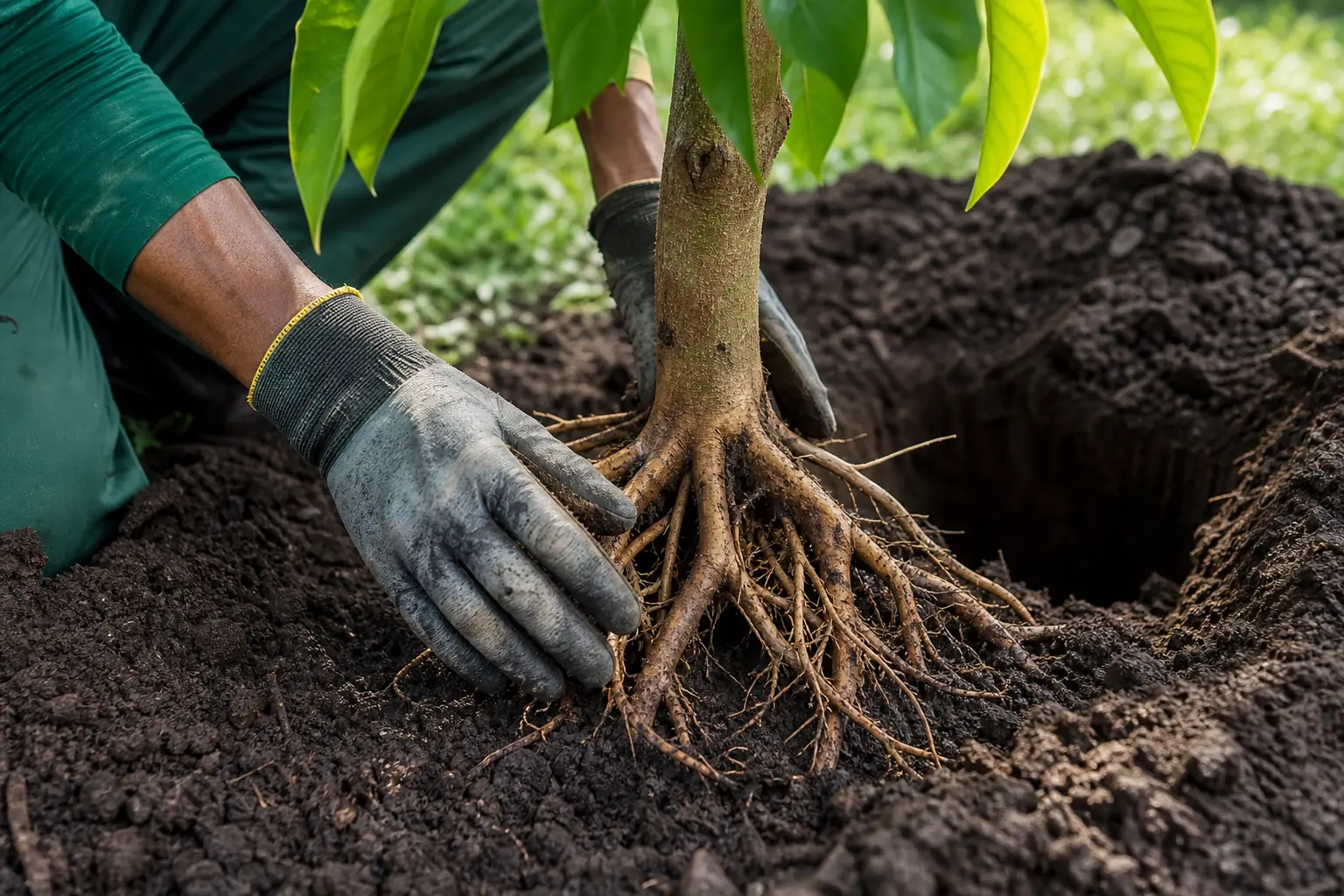
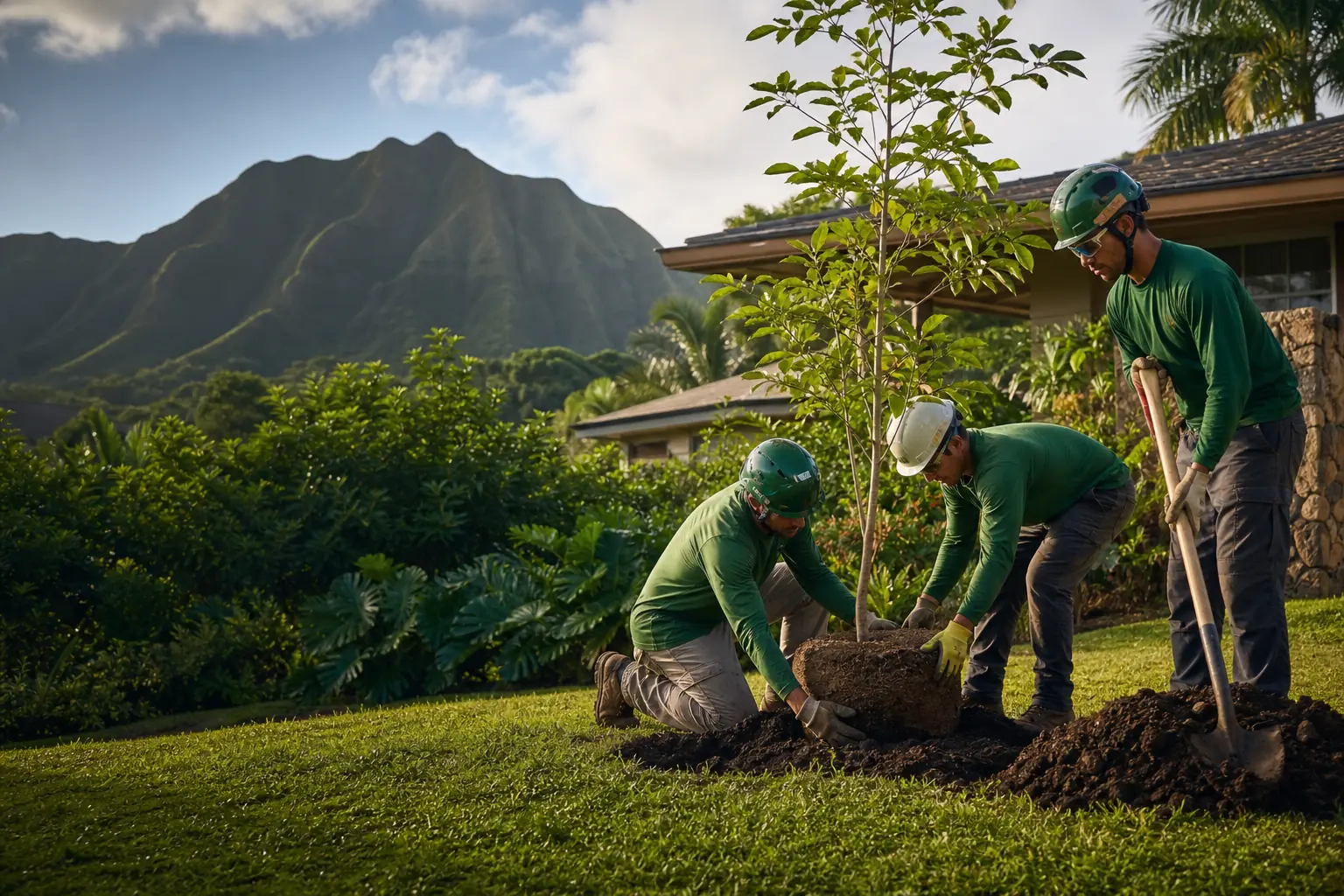
The most common planting mistake is a hole that is too narrow and too deep. We dig the planting hole at least twice the width of the root ball to allow lateral root expansion into loosened soil. Depth is set so the root flare sits at or slightly above grade — burying the root flare is one of the most common causes of long-term tree decline. Soil amendment is assessed site by site: Oahu's volcanic soils vary significantly.
The tree is set at the correct depth, backfilled with native soil (not amended soil mix unless specifically warranted), tamped gently to eliminate air pockets, and watered in with a slow deep soak. Stakes are set if needed — only for the first year, and only if the site has significant wind exposure. On exposed Oahu ridge lots and waterfront properties, proper staking prevents the root system from rocking before it is established.
You receive written first-year care instructions: watering schedule, mulch depth and placement (keep it away from the trunk), when to remove stakes, and what signs of establishment stress look like versus normal transplant response. We schedule a six-month follow-up visit to assess the tree's establishment progress. Most planting failures happen in the first year and are preventable with correct establishment care.
One thing we always say honestly: a newly planted tree in Honolulu's climate needs 12–24 months of consistent watering before it is truly established — especially in the drier areas of Oahu like Hawaii Kai and Pearl City. If irrigation is not in place, we discuss a watering plan before the tree goes in the ground. The best species choice does not overcome poor establishment care.
Ready to Plant the Right Tree for Your Site?
An ISA Certified Arborist assesses your site, recommends the right species, and handles the installation correctly.
WHAT WE HANDLE
We assess the site before recommending a species — not after you have already bought the tree.
Kou, hala, kukui, milo, wiliwili, and Hawaiian hardwoods planted on sites where they are appropriate for the soil, sun exposure, and available space. Native species are more resilient in Oahu's conditions and support local bird and insect populations. We assess site suitability before recommending a native species.
Planting fast-growing shade species for lanai, yard, and garden coverage. Species selected for mature canopy width, growth rate, and root behavior appropriate to the planting location — not just what is available at the nursery.
Mango, avocado, lychee, breadfruit, starfruit, and other fruiting species planted with guidance on site selection, rootstock, and establishment care. Fruit tree success in Oahu depends heavily on drainage and sun — we assess both before the tree goes in.
If a tree was removed due to disease, storm damage, or hazard, a replacement planting assessment ensures the replacement species is appropriate for the same site — and that whatever caused the previous tree's problems is addressed before the new tree goes in. Many removal situations have an underlying site condition worth understanding.
WHY SPECIES SELECTION MATTERS MORE THAN MOST HOMEOWNERS THINK
Fast-growing species planted too close to structures, utilities, or property lines are one of the most common sources of future tree service calls on Oahu. Albizia planted near a home. African tulip planted under a HECO line. A banyan with aerial root potential planted in a tight courtyard. These are all preventable with a site assessment before the tree goes in.
Native Hawaiian species are not always the fastest growing, but they are adapted to Oahu's specific soil and climate conditions and are far less likely to become invasive or structurally problematic at maturity. We prioritize natives where the site supports them — and explain clearly when an alternative species is a better fit.
Get the site assessment before you plant.
Free site assessment and species recommendation from an ISA Certified Arborist. No obligation to book the planting.
Call (808) 207-0841INSURANCE & COST
Planting trees on your private property does not typically require a permit in Honolulu. However, planting in the City right-of-way (the area between the sidewalk and the street) requires Division of Urban Forestry approval — including species approval. We check right-of-way status during every planting site assessment.
For properties subject to HOA architectural review, tree planting in visible areas may require board approval before installation. We can provide species documentation and mature-size specifications suitable for HOA submission. Some Oahu neighborhoods near conservation districts also have restrictions on planting non-native species — we check applicable restrictions before recommending a species.
Planting cost depends on tree size at planting (small caliper vs. large box specimen), species, number of trees, and site access. A small-caliper native planting is a quick installation. A large balled-and-burlapped specimen requiring equipment access is a larger scope. We give you a written price after the site assessment and species selection — before you buy the tree.
Want a straight answer on cost and coverage?
Call us with your details. We give you an exact written price and can tell you whether your situation has any coverage angle.
It depends on the site. In wetter areas like Manoa and Kaneohe, most tropical species thrive. In drier areas like Hawaii Kai and Ewa, drought-tolerant species are a better choice. For shade and canopy, monkeypod is classic Oahu — but its root system and eventual canopy spread require space. Native species like kou and hala are excellent choices for smaller sites. We assess your site before making a species recommendation.
Not for trees on your private property. Trees planted in the City right-of-way between the sidewalk and the street require Division of Urban Forestry species approval before installation. We check right-of-way status during every site assessment.
Oahu's mild climate allows planting year-round. The cooler, wetter months (November through March) reduce establishment stress and reduce the watering burden on newly planted trees. Avoid planting just before extended dry periods if irrigation is not in place. We advise on timing for your specific species and site conditions.
Larger trees establish more slowly than smaller-caliper trees — a small caliper tree planted correctly will often catch up to a larger specimen within 3–5 years. The right size depends on your timeline, budget, and the specific species. We advise on size during the site assessment and can source trees through our nursery contacts if needed.
Most species take 12–24 months to establish a root system capable of supporting the tree through dry periods without supplemental irrigation. Fast-growing species may establish faster. Slow-growing native hardwoods take longer. Consistent watering during the first two growing seasons is the most important factor in establishment success — we provide a written watering guide with every planting.